
Darcy Pattison's Blog, page 4
July 31, 2017
4 Years of Indie Publishing
NOW AVAILABLE!
The post 4 Years of Indie Publishing appeared first on Fiction Notes.
It’s been four years since I started along the exciting path of indie publishing my books. And lots has changed. Here’s the post I did 18 months in.
The first 18 months were spent in learning the technology to actually produce print or ebooks, getting distribution, and starting the marketing journey. Since then, I’ve produced more books; in fact, my publishing company Mims House, now has 35 books in its catalog. We’ve been recognized for excellence several times.
Starred Review in Publisher’s Weekly: Wisdom, the Midway Albatross
2015 NSTA Outstanding Science Trade Book: Abayomi, the Brazilian Puma
2017 NSTA Outstanding Science Trade Book: Nefertiti, the Spidernaut
2017 Fall Junior Library Guild selection: The Nantucket Sea Monster: A Fake News Story
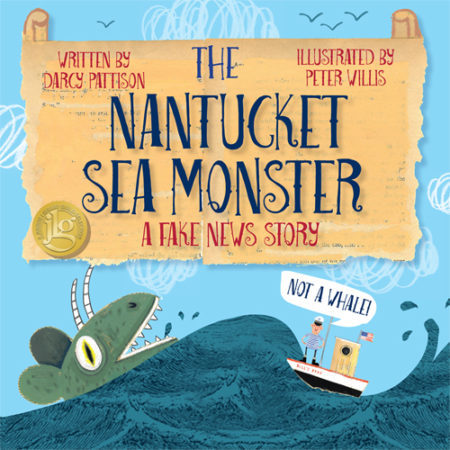
2017 Fall Junior Library Guild selection
As I’ve worked on books, Fiction Notes has fallen by the wayside.. And I think it’s time to move on.
Changing With the Times: Good-bye Fiction Notes
Fiction Notes has been a big part of my life for 8 years. It started slowly and innocently. A friend said, “Just write anything. Just try a blog.”
As I wrote fiction, I posted about my struggles and ways to overcome the writing problems. And it found – you – the audience who reads this blog. It’s been incredible to be a part of YOUR writing process. Thanks for all the emails over the years that a certain post resonated with you that day. It kept me writing.
But I think it’s time to stop writing for Fiction Notes for a while. I’ve done fewer posts this year than ever before, because I was distracted. But also because I feel like I’ve said most of the things I want to about writing. It began to feel very repetitive. I know that the early readers of the blog haven’t read everything; but for me, it was different, like I was writing to get traffic, instead of writing things that I was passionate about. Oh, I’m STILL passionate about my writing! And about teaching!
After 8 years, it’s time to change focus. All the content will remain up.
Who knows? Maybe I just need a short sabbatical and can come back with enthusiasm!
Where to Find Darcy Online
I’ll still be on Twitter @FictionNotes.
Find Darcy on Pinterest.
Mims House
You can buy my books at MimsHouse.com
Or keep up with my books on the Facebook page for Mims House
If you’d like to receive the Mims House newsletter, with behind the scenes info on forthcoming books, fill out the simple form here.
Thanks!
I hope you’ll come along with me on this adventure of putting great books into the hands of readers. But if you’re off on your own journey and need to focus elsewhere — well, it’s been fun!
As always, send me your good news!
The post 4 Years of Indie Publishing appeared first on Fiction Notes.
Releasing on July 11, 2017 - JUST 3 Weeks Away!
I'm looking for a few people to review my new middle grade, science fiction novel.
If you have interest and time, you can download a free copy here.
Download a Review Copy


July 17, 2017
Do You Use Swear Words in Your Fiction?
NOW AVAILABLE!
The post Do You Use Swear Words in Your Fiction? appeared first on Fiction Notes.
Do you use swear words, cuss words, or bad words when you write fiction? If you’re writing picture books, no. But as your audience gets older and older, they start to creep into fiction.
Guidelines for Using Swear Words in Fiction
There are a couple schools of thought about using swear words in your fiction.
Faithful to the Character. Some people would say that it depends on your character. If your character would normally swear, then you must stay true to him/her and allow the words into your fiction. For example, we can all think of an adult who’s a bit of a rogue and just swears habitually. They may be lovable in many ways, except their choice of vocabulary. Or, there are historical characters who absolutely would swear.
I understand this viewpoint, but it almost seems like the author is saying, “It’s not MY fault that character habitually swears.” But if you’re the author, it IS your fault that you put that character in this book. On the other hand, though, this all smacks of self-censoring, something we all wrestle with.
Invented Words. I’ve read a couple fantasy novels this month that used invented swear words for their universe. Here’s a couple I remember:
“Skies!”
“Rust!”
In context, these are probably mild swear words. In the character’s dialogue, the purpose of swear words is to express extreme emotions. Swear words do that with economy, even invented ones. Isn’t that hypocritical, though? The emotions behind real or invented swear words is the same. Within the context of the story, isn’t that invented word just as bad as a real swear word?
No Swear Words – ever. I’ve also heard people advocate a total prohibition on swear words in middle grade and young adult novels. The age at which they draw the line varies with fewer swear words for the younger audiences. The comment is usually that as an intelligent author, you should be able to express the appropriate emotions without resorting to swear words. I understand this one, too. Usually, there are alternate ways to express the emotions, often more powerful ways when the event is fleshed out. However, swear words are that convenient shortcut to emotions. Sometimes, you don’t have the space to flesh out the emotions.
I don’t have any answers. Just questions and issues to raise.
Personally, I’d love to ban all swear words from adults! But swear words are a shortcut to emotions, and I understand when people swear, even if I don’t like it. In my own fiction, I’d rather invent a swear word than use a popular swear word; but beyond that, I’d rather take the time to dramatize the emotions than to use even an invented swear word. The shortcut of swear words isn’t worth it to me. Instead, I’ll just work harder to convey one of these 63 emotions without swear words.
Set Your Own Boundaries
In the end, I think each author must decide what line to draw in the sand. The key thing to remember is that words have impact. An apt word especially has a HUGE IMPACT. This video expresses it in a unique way.
If you can’t see this video, click here.
So, do you use swear words in your fiction? Do you self-censor when you allow those words into your story? Where do you stand on the Swear Words continuum?
The post Do You Use Swear Words in Your Fiction? appeared first on Fiction Notes.
Releasing on July 11, 2017 - JUST 3 Weeks Away!
I'm looking for a few people to review my new middle grade, science fiction novel.
If you have interest and time, you can download a free copy here.
Download a Review Copy
July 11, 2017
Series Tips: Characters, Timeline & Plot
NOW AVAILABLE!
The post Series Tips: Characters, Timeline & Plot appeared first on Fiction Notes.
Are you interested in writing a series of novels, picture books or stories? Here are some series tips.
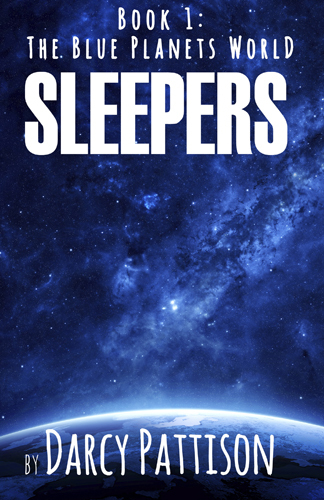
My first general tip is to use Scrivener. It’s the software designed for authors and writers. It allows you to arrange (and rearrange) chunks of story, much like an outline. There’s a visual aspect when you use the cards view. And it lets you keep research or reference files on anything you like. The binder area where files are listed has three basic divisions: Story, Other Files and Trash. Of course, you should rename these as you wish. You can import a webpage or photos, or just store text to which you’ll need to refer. Here’s the binder for my science fiction trilogy, The Blue Planets Series. Book 1, Sleepers is now available in stores.
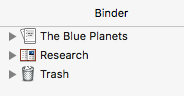
Scrivener’s Binder puts files into one of three basic areas: Story, Other Files, or Trash. You can rename these as you wish.
Affiliate Link
Here’s the files within those folders:
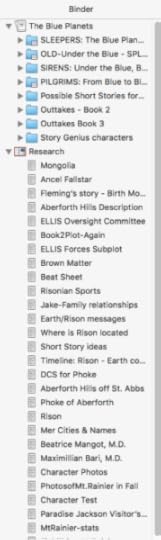
Here, the base folders are expanded so you can see files. Notice that there are 3 titles in the Blue Planets, along with OLD versions and Outtakes.
The three books in this trilogy are SLEEPERS, SIRENS and PILGRIMS. I also have files for OLD version, outtakes, and possible short stories within the series. The RESEARCH folder is full of important info that I don’t want to research over and over. Instead, I plop it into a file in Scrivener and I can easily find it when needed.
Character: Series Tips
For characters, you’ll see a couple files with character names. That’s where I put everything I can about the character’s background, how they look physically, family relationships. etc. I find the hardest thing to remember is sometimes the simple things like John has blue eyes.
Character growth is important to track. Your main characters should change somehow in each book; and over the series, there should be an overarching change. If they start out selfish, they should learn to think about others needs first. That sort of thing. I track these changes and key plot events that provoke the changes across individual novels and across the series.
New characters present a problem, as well, As the series moves locales, I need to create new characters. When I was working on Book 2, for example, I not only added characters, but I also had to keep track of old ones because characters will refer back to them. That’s why I love having all three books in this one file. The search function allows me to easily find the information from previous stories; at the same time, if there’s a reference file on that person, it’ll pop up, too. Continuity is so much easier in Scrivener.
Timeline: Series Tips
A trilogy is just one big story that spans a longer period of time. This story covers about a year.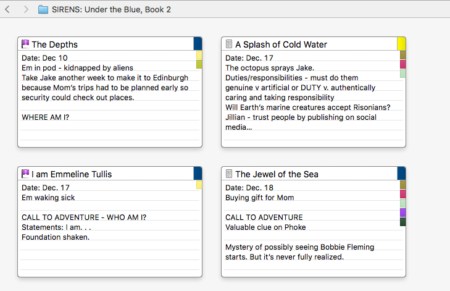
This is the card view in Scrivener. Here, I can jot down dates and track the timeline of the story.
For each chapter or scene, I jot down the date, and time if needed. Everything must fall in the right sequence (or be deliberately out of sequence), or the story falls apart. This also helps me notice the time of year and create appropriate details. Book 2, SIRENS occurs in late December to early January. That means I must include Christmas decorations, parties, etc. And then, a New Year’s Eve gala. It’s cold, especially in Edinburgh, Scotland where most of the events take place. The timeline grounds me in time and space.
Plot: Series Tips
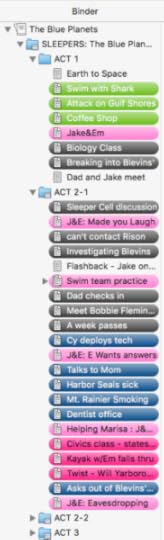
Scrivener’s Binder lets me use color to track plot.
For plotting, I love the ability to color-code files. The pink is the “love story plot” and I used other colors for other plot lines. I’ve always had trouble with subplots, especially, because it was hard to track the subplots across the whole story. As I tell students: It’s easy to write a chapter; it’s much harder to write a novel because you must track everything across a vast number of words. Color coding makes it easier for me.
Writing this science fiction trilogy has been much easier than previous attempts because I’ve organized it in Scrivener. A close look would reveal that it’s still a pretty messy organization. That’s why the Search function is my best friend.
Here’s my best tip on writing series: devise a way to track the characters, plot, and timeline across the story. You can choose to do it with paper files somehow, but for me, Scrivener works best.
Now Available: Book 1, The Blue Planets World series, SLEEPERS
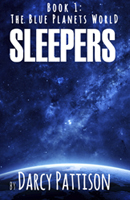
Click cover for more information
The post Series Tips: Characters, Timeline & Plot appeared first on Fiction Notes.
Releasing on July 11, 2017 - JUST 3 Weeks Away!
I'm looking for a few people to review my new middle grade, science fiction novel.
If you have interest and time, you can download a free copy here.
Download a Review Copy
June 19, 2017
Long Cooling Off Period – Stuff Your MSS in a Drawer!
Releasing on July 11, 2017 - JUST 3 Weeks Away!
I'm looking for a few people to review my new middle grade, science fiction novel.
If you have interest and time, you can download a free copy here.
Download a Review Copy
The post Long Cooling Off Period – Stuff Your MSS in a Drawer! appeared first on Fiction Notes.
My stories have been enjoying a long cooling off period. I’ve been SO busy the last two months getting ready to teach at Highlights Foundation next week. There will be a class on writing picture books with the amazing Leslie Helakoski (see her new book here – really, if you’re looking for a gift, this is a gorgeous and funny book). And, I’ll be teaching about self or indie publishing, based on my work at Mims House.
Basically, that means, I haven’t written fiction in about eight weeks.
I’m going to have a blast teaching next week.
But I’m SO ready to get back to fiction.
I have two stories waiting, and a picture book that I’m anxious to start.My science fiction novel, SLEEPERS, Book 1 of The Blue Planets World series comes out in three weeks.
Books 2 and 3 are waiting for me to pay attention to them. Hello! I’m coming! Soon!
After a Long Cooling Off Period . . .
. . . you read with fresh eyes. What does that mean? Essentially, you’ve forgotten parts of the novel! Yes, the author forgets what they’ve written. This is a good thing because you’ll be able to revisit the story while pretending you’re the reader.
Good revising starts with that focus on the reader, not the author. Some things I’ll notice as I read:
Awkward. If I pause at all int he flow of the story, I’ll read it aloud. Wow, that’s such a great way to catch phrases that will trip up a reader.
Skipping ahead. Oops. If I find myself skipping ahead, I look at the text much closer to be sure it’s interesting.
Zoning out. Yeah, if I am zoning out. . .
Confused. Sometimes, if find that I must sort out dialogue without enough attributions; or, who was hitting whom; or, where these characters are in the setting. When confusion arises, I try to pinpoint exactly what’s confusing and fix it.
Neutral emotions. While reading, your emotions should yo-yo, circle back, and generally get jerked around. If I’m just reading along with no emotional spikes, the story needs work.
In the end, I’m always glad I’ve let a story sit for a while. At the time, it feels strange, like I’m abandoning a friend. But when I come back to it, I know I make it stronger because I’ve been away.
Do cooling off periods seem strange to you?
The post Long Cooling Off Period – Stuff Your MSS in a Drawer! appeared first on Fiction Notes.
Releasing on July 11, 2017 - JUST 3 Weeks Away!
I'm looking for a few people to review my new middle grade, science fiction novel.
If you have interest and time, you can download a free copy here.
Download a Review Copy
May 25, 2017
Quotable: Using Quotes as Marketing Material
Click Image to Join Readers Group - Be the First to Know When the Book is Available
The post Quotable: Using Quotes as Marketing Material appeared first on Fiction Notes.
Quotes on the internet are an interesting thing. A year or so ago, I wrote a post called, “32 Quotes To Make Writers Weep, Cry, Laugh, Shout, or Jump for Joy.” I wanted something to share on social media about my video course, “30 Days to a Stronger Novel.” I did 32 quotes because they are also included in the video course.
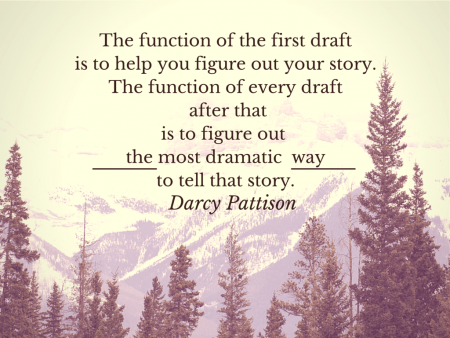
This quote originally appeared in 2015, and is now out in the wild!
Using Quotes to Market Your Book
I started thinking about these quotes. First, they are out in the wild and the above image appears randomly on social media. It’s amazing how it comes back and comes back. In other words, it keeps on working for you long after you’ve released it. On Pinterest, such an image can have a life measured in years.
You’ll see that I made one huge mistake on the image. There’s no website listed to send people to look for more info.
A second thing started me thinking about quote as marketable material, and that’s Goodreads. I stumbled across their quotes feature by accident. For example, look at the quotes from the Newbery book, The One and Only Ivan by Katherine Applegate. Although it’s a relatively short book, there are 30 quotes. Read how to add your favorite quotes on GoodReads.
So, I’m asking myself: in my novel, did I write something quote-worthy?
Would anyone take the time to quote from my book on Goodreads?
Maybe, I could help them along!
My secret weapon is Canva.com, the site which lets you create images of all sorts. I love that they have templates in the correct sizes for different social platforms. Many image elements are free and you can upload your own images. When you need to purchase an image, it’s only $1. The price is right; the templates are awesome.
So, here’s a couple that I created for forthcoming books.
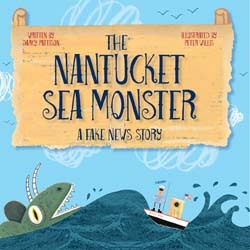
These quotes come from the back matter of my forthcoming picture book, The Nantucket Sea Monster: A Fake News Story. 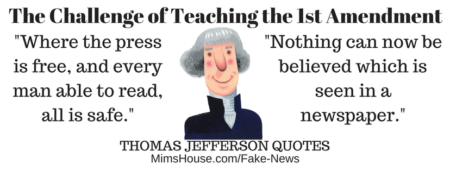
And this quote comes from my forthcoming novel, Sleepers, Book 1, the Blue Planets World series.
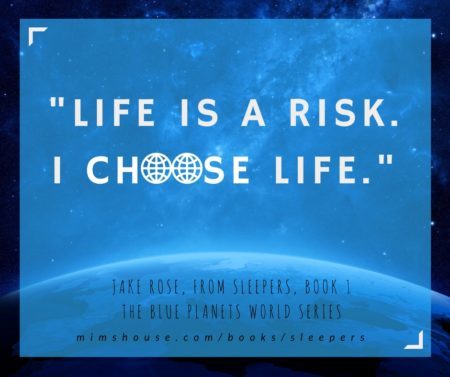
The nice thing about using quote-images is that it’s zero cost, it lasts a long time, it’s a gift to your audience because the quote means something even out of context, and it gives your readers talking points so word of mouth is more likely.
Creating Your Own Quotes
Make sure you write something quotable.
Choose several quotes, instead of just one. The more, the merrier.
Use Canva.com or a similar service to create striking images. Keep it clean and simple. Make sure the fonts are easy to read.
Make sure you include a website URL on the image.
Share on your favorite social media platform and ask friends to SHARE, RETWEET, LIKE, etc. Refrain from saying much more about the book. Instead, let the quote do its work.
Work on your next book, making it even more quotable.
The post Quotable: Using Quotes as Marketing Material appeared first on Fiction Notes.
Join Darcy in a Writing Retreat
June 22-25, 2017,
PB&J: Picture Books and All That Jazz
June 19-22, 2017,
Self or Indie Publishing: Answering the Big Questions
May 15, 2017
Picture Books That Soar – With Leslie Helakoski
Click Image to Join Readers Group - Be the First to Know When the Book is Available
The post Picture Books That Soar – With Leslie Helakoski appeared first on Fiction Notes.
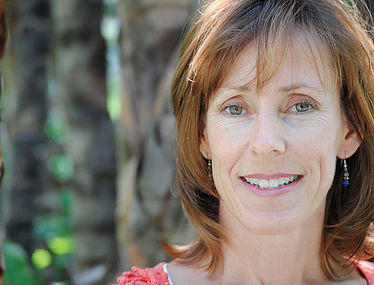 For the past few summers, I’ve co-taught a picture book workshop with author/illustrator, Leslie Helakoski at the Highlights Foundation. HOOT AND HONK, Leslie’s newest picture book, follows an owlet and a gosling, who have trouble adjusting to sleep patterns when they end up in each other’s nest. The spare text in this beautifully illustrated bedtime story means each and every word has to count.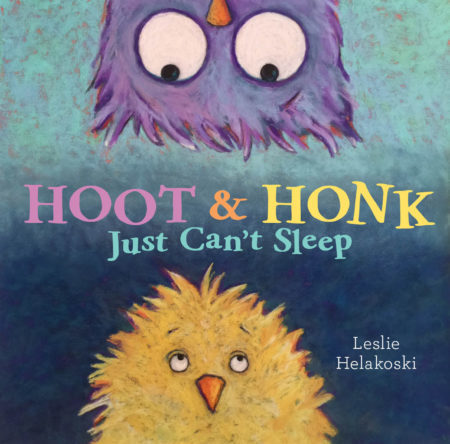
This summer, we’re teaming up for another fun-filled learning experience. With Author Kelly Bennett, Blue Sky/Scholastic Editor Natalia Remis, and Boyd’s Mills Art Director Tim Gilner all giving guest presentations, it’s going to be packed with valuable information.
Join us at the PB&J: Picture Books and All that Jazz workshop, June 22-25, 2017.
Meanwhile, here’s a post co-written with Leslie. It gives you a taste of the topics we cover in the workshop.
Words That Soar
What are your words doing for you other than giving the reader information? Choosing words carefully can do more than define. Is your story lulling a child to sleep? Or helping them zoom and zip? Do you want an organized military feel or a meandering wandering feeling? Word choice–even the sound of the words–can make the difference between a picture book manuscript that soars and one that stays grounded.
Word Choices
Because each word in a picture book is at a premium, choose words that do double duty. Perhaps the words convey the action but also echo a mood of the piece or the feeling of a character.
“Big chickens run across a field.”
Compared to:
“Big chickens tiptoe across a field.”
Changing the verb to “tiptoe” adds tension and conveys the idea that these chickens are trying to get away with something–all that extra info with one word!
PLACEMENT OF WORDS
Another idea to consider is the placement of the power word in a sentence. What word is most important? Should it be at the beginning middle or end of a sentence?
She needed to stop running.
Compared to:
She needed to stop.
The first example puts STOP in the middle of the sentence, which weakens the meaning and instead emphasizes the running. In the second sentence, STOP is a one-syllable word that ends abruptly. Reading that sentence transforms the words into an experience of stopping.
RHYTHM OF WORDS
By adjusting rhythm, word choices can direct where a reader should pay attention.
But I have to admit, two DOES sound like fun.
Compared to:
But I have to admit that TWO sounds like fun.
Rhythm matters even if you are not writing in rhyme. Where do you want the emphasis to fall? On the word TWO or the word DOES? TWO makes a more powerful impact especially if this is a counting book or involves numbers. Keep the emphasis on key words when possible. To complicate your word choices, you should make your words fall into line like a natural speech pattern.
SOUND OF WORDS
Phonics plays a part too. Higher vowels like long a (gate), long e (see) and short i (pig) are building blocks for rising action while lower tones such as long oo (boot), ah (fog), and short oo (book) can bring home a line.
“Four big chickens strutted all the way home.”
Compare to:
“They strutted home like four big chickens.”
In the first example, the low tones in HOME make it a good closing word. The second sentence leaves an unsettled feeling, as if something else should follow.
In general, the higher vowel sounds are light and airy instead of grounding like lower tones. Sometimes, thank goodness, we do this unintentionally and don’t even know why one way sounds better than the other but if we dig around, we’ll find that it is tonal or related to phonics.
We love playing with words and the more we play with them, the more powerful we find them to be. They go far beyond definition–shape, length, mood, sound all play a part in making a good story one that is a joy to read.
–Leslie Helakoski and Darcy Pattison
Join Darcy Pattison and Leslie Helakoski as they play around with words at the Highlights workshop, PB&J (Picture Books and All That Jazz) June 22-25.
The post Picture Books That Soar – With Leslie Helakoski appeared first on Fiction Notes.
Join Darcy in a Writing Retreat
June 22-25, 2017,
PB&J: Picture Books and All That Jazz
June 19-22, 2017,
Self or Indie Publishing: Answering the Big Questions
April 28, 2017
Drone’s Eye View of Your Manuscript
Click Image to Join Readers Group - Be the First to Know When the Book is Available
The post Drone’s Eye View of Your Manuscript appeared first on Fiction Notes.
June 19-22, 2017,
Self or Indie Publishing: Answering the Big Questions
April 24, 2017
3 Ways to Show Don’t Tell
Click Image to Join Readers Group - Be the First to Know When the Book is Available
The post 3 Ways to Show Don’t Tell appeared first on Fiction Notes.
Classic advice to beginning fiction writers: Show, Don’t Tell. I taught several sessions to teachers last week and they all nodded. Great advice. But how do you DO that in practical terms? How do you teach students to Show, Don’t Tell?
Show, Don’t Tell: Why?
In the old days of storytelling, it was fine to just say something like this:
The cat was cuddly.
But in today’s fiction, we usually want that fleshed out more. Novels and picture books try to put readers in the immediate situation. Generic or cliched descriptions like that give only a surface experience, rather than the sensation of being in a situation. Of course, sometimes that statement is fine, depending on how much attention you want to give the cat and the fact that it is cuddly. But if the cat is important and its tendency to cuddle even more important, you must do better.
Verbs and Nouns
One hint is to do away with as many “to be” verbs as possible. In our sample sentence the “was” indicates a state of being; instead, we want action.
The calico cat purred in the hammock, snuggled on the couch, and when I slept, she curled on my chest.
My general rule is no modifiers UNTIL I have the most exact verb possible. Get rid of wimpy -ly adverbs, in favor of a precise verb.
Likewise, use the most exact noun possible. Only then, may you add modifiers. In this case, just naming the type of cat seems enough for me, because the rest of the text does the expansion.
Sensory Details
The information that we, as humans, receive from our senses can be used to revitalize tired prose. What you see, hear, taste, smell and touch (temperature, texture and kinesthetic) should be included whenever possible. Visual details are the easiest and most common to add. Fine. Use them. But try to add at least one or two other senses to your prose.
The calico cat purred in the hammock, snuggled warm on the couch, and when I slept, she curled on my chest and her soft fur tickled my chin.
Dialogue
Finally, you can often turn a flat narrative into dialogue, thus bringing to life the situation. The problem here is to make the dialogue dynamic. You don’t want to go into long monologues when snippets will do.
I dangled my hand. “Come.” Obedient, the calico cat leapt into the hammock and settled down to purr. Later, when I watch TV, she snuggled warm against my thigh. And when I slept, she curled on my chest. “Quit tickling,” I murmured and pushed her away from my chin. I’d never had another cat who liked to snuggle as much as this calico.
As you can see, the problem with Show, Don’t Tell is that it adds length to a story. You must weigh the importance of the cat and decide if it is worth the extra space.
The post 3 Ways to Show Don’t Tell appeared first on Fiction Notes.
Join Darcy in a Writing Retreat
May 5-7, 2017, NOVEL REVISION RETREAT, Syracuse, NY
June 22-25, 2017,
PB&J: Picture Books and All That Jazz
June 19-22, 2017,
Self or Indie Publishing: Answering the Big Questions
March 21, 2017
Pen Names: Do You Need One?
Check These Out
The post appeared first on Fiction Notes.
When, if ever, do you need a pen name? Why would you want one? Do pen names give you privacy and are they worth the bother?
Privacy
One main reason that people want to use a pen name is privacy. They don’t want to be recognized in person or online as an author. You might think that’s only for people writing porn, but it has other uses. Some people really don’t want the notoriety that comes with publishing a book. For them, they want a strict dividing line between work and home. I have a friend who is intentionally building a different identity online for her writing.
Different Genre
So, if you write porn, and you don’t want folks to know, you can choose a pen name. But this also works for people who want to write in several different genres. Let’s say that you want to write adult mysteries and children’s nonfiction science. The two genres have wildly different audiences, so there’s no advantage to using your name on both. Further, if you wanted to develop a website or utilize any online identity to market, it might be easy for readers to get confused.
Perhaps, you want to use your initials in science fiction writing, something women writers often do. But for romance, you want your full name, including your maiden name. Some perceived–whether real or not–advantage to one name or the other is reason enough to use a pen name.
Work for Hire
I’ve done a couple work-for-hire projects and I considered using a pen name for those projects. The projects, though, weren’t vastly different from my normal books for kids, so I left it alone. If however, I did a WFH project for adult software, it might make sense to separate the two audiences.
Fresh Start
What if you’ve made some “horrible mistake” in your career? You allowed a certain book to be published, and now, you’re moving a different direction? Use a pen name. It can give you a fresh start with a chance at a fresh career.
How To Use a Pen Name
Do you have to tell your editor that you’re using a pen name? I think most people would bring the editor into the story of the pen name. But you don’t have to! Look up Sue Denim (pseudonym – get it?) on Amazon and you’ll see several children’s books about the Dumb Bunnies. These were actually written by Dav Pilkey and the name was, of course, a big joke. The Scholastic editor who pointed this out said that in the author’s file, there was a photo of someone bundled up with a hat, scarf, etc. In other words, unrecognizable. Even working with Sue Denim, it took the Scholastic editor a while to figure out the joke.
The one place where you must think hard about the pen name is when the copyright is registered. What name do you want the copyright under? Your name or your pen name?
You can register with your state for a “doing business as” name, a simple process. Then, you could use that name. Alternately, you can set up an LLC (a type of corporation often used by small companies) as a legal entity and use that in the copyright registration. Whatever you choose, the copyright registration is an important step to think about.
Pen names can give you a separate identity for many reasons. Often, however, the pen name is outed. Lemony Snicket is really Daniel Handler. It may remain secret for a time, but usually the pen name is connected with you. You may be fine with keeping the porn secret until your kids are grown and then you don’t care. But eventually, there’s a good chance it will come out. Keep that in mind, if you choose a pen name drastically different than your own.
The post appeared first on Fiction Notes.
Join Darcy in a Writing Retreat
May 5-7, 2017, NOVEL REVISION RETREAT, Syracuse, NY
June 22-25, 2017,
PB&J: Picture Books and All That Jazz
June 19-22, 2017,
Self or Indie Publishing: Answering the Big Questions
March 13, 2017
Are You Being a Lazy Writer? Stop it!
Check These Out
The post Are You Being a Lazy Writer? Stop it! appeared first on Fiction Notes.
I’ve been reading a lot of manuscripts lately and finding some common problems.
Matching up writing and audience
One problem is matching up the story with the audience. For example, ABC stories are perfect for kindergarten and first graders. An ABC book for sixth graders would be rather pointless. On the other end of the scale, I’m seeing easy chapter books written in a narrative style more suited for sixth grade. The sentence lengths, vocabulary and tone are meant for older students. The story itself might be fine, but the writing choices mean it doesn’t match the intended audience.
Think about your novel. Are you writing for YA, but your story is about something simple like deciding what to eat for lunch or what to wear to school. Sure, you can make those work in a YA (don’t send me samples!). But usually those are too simple and lack the complexity for the teenage concerns. Or are you writing for preschoolers? Then, a concept book about Big vs. Little would be perfect. But a technical explanation of Bernoulli’s principle that creates lift for airplane wings would not work for preschoolers.
Make sure you’re matching up audience, story, plot, characterization, narrative style, tone and so on.
Lazy writing
I’m going to be generous and slot another set of problems into a Lazy Category. Otherwise, I’d have to say the writer is incompetent and needs to learn the craft better. This includes too many to-be verbs, failing to imagine the world and its sensory details, boring dialogue, and so on. Or, there’s a story there, but the pacing is off and entire chapters are boring. Or the chapter reads fine, but nothing happens. Nothing changes for the characters, so it’s an empty chapter.
These writers need to remember their craft, learn it, or relearn it. Often, I’ve seen great writing from this person, but in this story, it’s off. Maybe they weren’t passionate enough to read the story another time, and make the needed changes. Or, they are distracted by something in their lives. In this case, the writer needs to go back to his/her roots and do the things they know how to do. Storytelling needs a certain concentration and mindset and it’s hard to maintain. We inevitably find variation in the quality of writing from story to story.
This is a call to be vigilant and make sure you maintain a high quality in your work.
Failure to edit
Some writers are lazy for various reasons. Less easy to understand are those writers who shrug about doing a last run through for editing. I know! I hate doing that spell check, reading again for clarity and word choice, and being vigilant about punctuation complexities. But I do it. It’s a matter of quality, yes. But I also think it’s a matter of being polite.
Punctuation and grammar are, by and large, a matter of being polite. It’s often not a matter of right or wrong. Rather, they are commonly agreed upon rules that show where our prose needs to pause, emphasize, or diminish something in the text. If you use a short sentence, it stops the reader. Cold. It’s one of the tools by which we direct the reader toward meaning.
If you deliberately misuse or ignore the common rules, it’s rude to your readers. Good writers edit. And if they are incapable of doing it themselves, they find copy editors to help.
Someone once asked me how many times I’ve read my stories before they are published. It feels endless! Doesn’t it?
But good writers are vigilant about the quality of their writing. They make sure the story and audience match up, they refuse to be lazy, and they do the polite work of editing their work.
The post Are You Being a Lazy Writer? Stop it! appeared first on Fiction Notes.
Join Darcy in a Writing Retreat
May 5-7, 2017, NOVEL REVISION RETREAT, Syracuse, NY
June 22-25, 2017,
PB&J: Picture Books and All That Jazz
June 19-22, 2017,
Self or Indie Publishing: Answering the Big Questions


