
Darcy Pattison's Blog, page 21
June 2, 2014
Book Reviews on Your Author Website: A Surprisingly Simple Widget
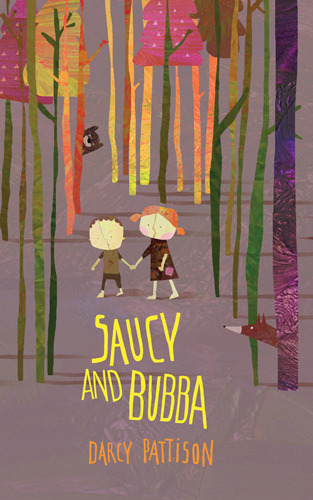
" Saucy is a real character dealing with real stuff—hard stuff that doesn’t have easy answers, not in real life and not in fairy tales, either. This is a really compelling and ultimately hopeful story. Highly recommended."
– Debby Dahl Edwardson, National Book Award finalist and author of My Name is Not Easy
Read a sample chapter.

Why do most online sites include reviews of products? It’s called social proof. If someone else likes a product, you’re more likely to be interested. For clothing, I like to see if the sizing is correct, or if I should buy up or down a size. For household appliances, I read to find out what washing machines are noisy or how they hold up to heavy loads. Book reviews act in the same way. Add a couple reviews to your book and sales climb. How much? That’s the million dollar question! We don’t know exactly how the two correlate, but we know that they do.
Adding reviews of your book to your website is simple. Earlier, I did a series on setting up your author website which covered the basics of setting up your site. This is an extra, but potentially important extra.
Goodreads Widget
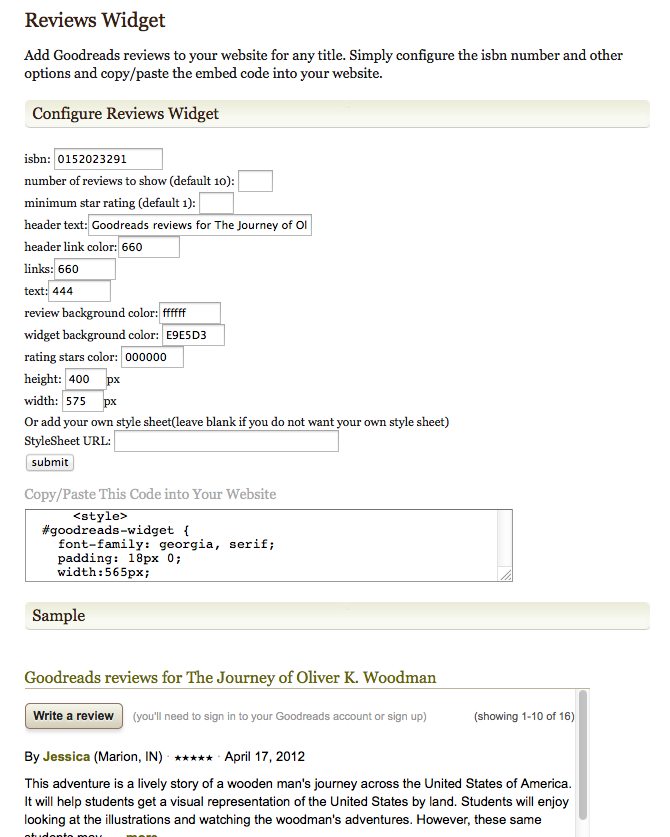
Configure the GoodReads Review widget as you like, the copy/paste the code into your site.
Goodreads makes it simple to add a Review Widget to your site. Here’s how.
Log into your Goodreads author account.
From the Home Page, right sidebar, click on Visit Your Author Dashboard.
Make sure your account is updated and you have claimed all your books. If this is your first time to set up an Author Dashboard, be sure to read the Author Tutorial linked in the sidebar.
Click on Author Widgets in the sidebar.
Scroll down to the Reviews Widget and click on Configure & Add Widget.
Use the ISBN number to find the right review and configure as you want.
Copy the code provided and drop into your website where you wish.
Note: For the code to work in WordPress, you must paste it into a TEXT editing area, not a VISUAL editing area. You’ll find this tab at the top right of the editing area.
Example of GoodReads Widget in Action
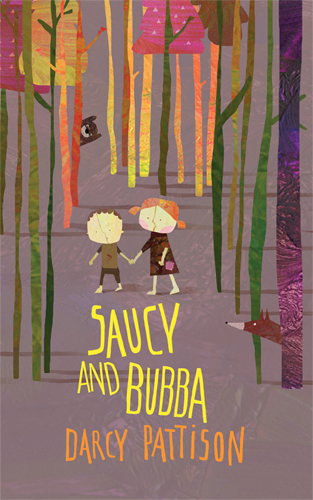
Saucy and Bubba. A Contemporary Hansel and Gretel Story.
Below is what the GoodReads Review Widget looks like for my novel, Saucy and Bubba.
Or, see how it is used in a separate tab on the Mims House eBookstore for Wisdom, the Midway Albatross.
Goodreads reviews for SAUCY AND BUBBA
Reviews from Goodreads.com
Kobo Reviews
On a related development, Kobo eBooks (Here’s a post I did about Kobo and why you should pay attention to it.) has recently announced that they will no longer use GoodReads reviews on their site. This makes sense because Amazon bought out GoodReads a couple years ago. Using reviews from a competitor is bad business. Instead, Kobo will be developing its own set of reviews on its site. For a short time, authors can take control of that and ask fans to add reviews on Kobo. So, here’s my request. If you have read and enjoyed one of my books, I’d appreciate a review on Kobo. If you just rate the books (give it some stars!) that helps, too.
To ask for reviews on your own Kobo books, just change the name at the end of the URL, using a plus sign between first/last names. You’ll see which of your books are offered on Kobo.


May 28, 2014
5 Interesting Podcasts: Kidlit, Social Media & Self-Publishing
" Saucy is a real character dealing with real stuff—hard stuff that doesn’t have easy answers, not in real life and not in fairy tales, either. This is a really compelling and ultimately hopeful story. Highly recommended."
– Debby Dahl Edwardson, National Book Award finalist and author of My Name is Not Easy
Read a sample chapter.
With limited time to keep up on the business of writing and publishing, I have found myself turning to podcasts. A podcast is like a radio program, but you can play it on demand. To listen, I have the Pocket Casts Lite app on my iPhone; the free version allows me to set up five podcasts to follow. I listen while I’m at the gym or taking a walk using ear buds; I have a wireless bluetooth earbud setup, so I don’t have to worry about cords. Or, I plug into the auxiliary input on my car radio/cd system to listen. At home, I have a portable bluetooth speaker that sounds great. Of course, you’ll need to find a set of apps for your particular system. If you already have something set up to listen to music on your smart phone, just use that same thing for listening to podcasts.
Using Pocket Casts Lite, I can log onto the iTunes store and search podcasts to find something I want to listen to. My friend who write history nonfiction, tends to listen to history podcasts for tidbits that might spark an idea. No, really, she just listens to them for pleasure! If it sparks something, great. Almost any topic that interests you, there’s a podcast. Here, I’ll mention five podcasts that I’ve been listening to lately.
If you’re interested in just hearing authors talk about their books–and not the publishing side of it all–then you can look at podcast lists here or here, here or here.
Children’s Literature.
Katie Davis’s Brain Burps is the longest running podcast about children’s books. Each week, she interviews someone about their work and publishing experience, provides a book review and gives tips. Find her on iTunes.
Cheryl Fusco Johnson takes a slightly different approach to podcasts by using a local access radio station, KRUU in Fairfield, Iowa for her show, The Studio. For her show, you must download files and put them on your smartphone like you would a music file. Her interviews are with a wide-ranging set of authors–always interesting.
Book Marketing.
One of my favorite podcast is Social Media Marketing with Michael Stelzner, which isn’t necessarily about book marketing, but about using social media in general. It comes from the folks at SocialMediaExaminer.com and some of their strategies are stellar tools for your book marketing. Look for it on iTunes.

Self-Publishing
There are strong podcasts for self-publishers, including Joanna Penn’s Creative Penn Podcast. She’s got a long record of interviewing the most successful self-publishers and being on the cutting edge of new developments.
But my favorite right now is Simon Whistler’s Rocking Self Publishing Podcast. Yes, I was just interviewed on this podcast, but I have been listening to it for the last few months because of Simon’s great British accent. He’s got one of the best radio voices around right now. Simon’s interest in self-publishing is–of course–doing narration of audio books. But ont he podcast, eh talks to a wide range of authors about their publishing experiences.
What apps do you use to listen to podcasts? What is your favorite podcast?
May 23, 2014
Rhyming Dictionaries
" Saucy is a real character dealing with real stuff—hard stuff that doesn’t have easy answers, not in real life and not in fairy tales, either. This is a really compelling and ultimately hopeful story. Highly recommended."
– Debby Dahl Edwardson, National Book Award finalist and author of My Name is Not Easy
Read a sample chapter.
Yesterday, I was working on a picture book with rhyme in it. Now, I have two great rhyming dictionaries that I use. Yes, two. Because they are organized differently and provide slightly different answers. In addition, I use Rhymer.com, because again, it’s organized slightly different and has slightly different answers.
But my dictionaries are old and literally falling apart.
I need suggestions and recommendations. I am thinking that I want an ebook version so I can use the search function; that means it will need to be a recent publication date.
What rhyming dictionary would you recommend and why?
Did you know that there’s a Hip Hop Rhyming Dictionary? Crazy!
And lots for song writers.
Suggestions?
May 21, 2014
Thank You, AuthorCentral
" Saucy is a real character dealing with real stuff—hard stuff that doesn’t have easy answers, not in real life and not in fairy tales, either. This is a really compelling and ultimately hopeful story. Highly recommended."
– Debby Dahl Edwardson, National Book Award finalist and author of My Name is Not Easy
Read a sample chapter.
One of the online tools I use weekly is AuthorCentral.com, which is an Amazon site with a backend for authors. It gives authors access to the listings about your book, statistics about sales, reviews of all your books on a single page and access to Amazon for correcting mistakes.

Typical page from AuthorCentral. I’ve just “claimed” by Aliens, Inc. Series which will be out in August, 2014.
Book Listings. When you log onto AuthorCentral, the first thing to do is claim your books. Click on the Books tab at the top, and then ADD BOOKS. Once the process is completed, you’ll have access to the book listing, book details and book extras. These shouldn’t be changed willy-nilly, as your publisher has likely spent time in honing the description. But you do have access to change anything that is wrong, to add good news about awards and such, and to tweak as needed. Indeed, there is a space for “FROM THE AUTHOR” which gives you the perfect place to add information. The Book Extras are primarily intended for Shelfari, which isn’t one of the most popular sites; often, I don’t bother to do anything here. But it’s available if you like.Profile. The profile tab offers simple access to your Amazon Author page, something you want to update a couple times a year, or as new information is available. Included are you bio, bibliography, photos, videos, blog feeds and the ability to list events.
Sales Info. This includes sales data over time and by geographic region, as reported by BookScan. That is important: this only includes sales data from BOOKSCAN. Still, this is important and helpful. Say you visited California and wanted to know the effect of that visit on sales. You could check the sales data the next week. The information is also broken down book by book.
Author Rank. Just like Amazon gives your books a sales rank, it also gives YOU a sales rank. For a certain time period, how did your sales stack up against other authors in your category? I tend to ignore this one.
Customer Reviews. On the other hand, I check my customer reviews about once a week. It’s convenient to have all reviews from all your books in one central location. Otherwise, I’d have to visit each book listing on Amazon to see new reviews. It’s a bit slow (24-48 hours) pulling in a review. When a friend emails to say s/he has posted a review, I can check the book page and see it immediately; however, it doesn’t show up on AuthorCentral for a day or two.
Overall, these tools allow writers to keep a pulse on their book sales. It’s been a valuable addition to my set of online marketing and promotional tools. Thanks, AuthorCentral.
May 20, 2014
Japanese Audience: Your Books Travel the World
" Saucy is a real character dealing with real stuff—hard stuff that doesn’t have easy answers, not in real life and not in fairy tales, either. This is a really compelling and ultimately hopeful story. Highly recommended."
– Debby Dahl Edwardson, National Book Award finalist and author of My Name is Not Easy
Read a sample chapter.
When you sit in your home office and write, do you think about reaching kids around the world?
Neither do I.
Yet, I’ve been privileged to be published in eight languages: Swedish, Danish, Norwegian, German, Arabic, Chinese, Spanish and English.
My books have been read by children and adults across the globe. That’s an amazing thing.
 I just learned that Wisdom, the Midway Albatross will be on the 2014-15 Reading List for the Sakura Medal, which is a children’s book award given by the international schools in Japan. The award reaches 15,000 students on 25 schools.

When WISDOM, THE MIDWAY ALBATROSS was published, I always hoped the book would find its way to Japan. While the story focuses on how the oldest bird in the world surviving the Japanese tsunami, the story is also about that March 11, 2011 earthquake and tsunami. From that tragic natural disaster have come many stories of courage and survival. I hoped that Wisdom’s longevity in the face of nature’s forces would be an inspiration. Maybe one day, there will be a version in Japanese.
Thank you, Sakura Medal for allowing us to share Wisdom’s story with a Japanese audience. And thanks for letting me share my good news.
Read more about Wisdom here.
Where have your books traveled? What languages are your books translated into? What language do you WISH to be translated into?
May 19, 2014
Elizabeth Dulemba on Editing (a.k.a. Puzzle Building)
" Saucy is a real character dealing with real stuff—hard stuff that doesn’t have easy answers, not in real life and not in fairy tales, either. This is a really compelling and ultimately hopeful story. Highly recommended."
– Debby Dahl Edwardson, National Book Award finalist and author of My Name is Not Easy
Read a sample chapter.
Guest post By Elizabeth O. Dulemba
When my novel A BIRD ON WATER STREET sold to Little Pickle Press, I hadn’t looked at it for a while. In fact, it was in a drawer when the acquiring editor said (in response to a younger book I was pitching), “You know what we’re really looking for is an environmental novel. You don’t have one of those lying around do you?” As a matter of fact, I did . . .
A BIRD ON WATER STREET is a coming of age story about Jack, a boy growing up in a Southern Appalachian town environmentally devastated by a century of poor copper-mining practices and pollution. Jack is opposed to the mine where so many of his relatives have died, but how can he tell that to his Dad who wants him to follow in the family trade? Jack just wants his dad safe and the land returned to its pre-mining glory with trees, birds, frogs, and nature—like he’s learning about in school. After Jack’s uncle is killed in a mining accident and the Company implements a massive layoff, the union organizes and the miners go on strike. It seems Jack’s wish is coming true, nature begins to creep back. But the cost may be the ruin of his home and everything he loves.
It was definitely an environmental novel.
But I had put A BIRD ON WATER STREET in a drawer, after what I know now, was only a handful of rejections. Pah! Maybe it was for the best, though. As the manuscript sat, I grew in my craft. I studied and wrote and became a better writer. I knew that someday I’d go back to the story and would tackle it with objective and more skilled eyes, which is exactly what happened.
At Little Pickle Press, I also got to work with a great editor—Tanya Egan Gibson. I’ve been working in critique groups and with first readers long enough to know a good editor when I come across one. Not everybody has the chops to do it, even if their intentions are good. It takes more than just giving positive feedback. It takes being able to pull out the problems and perhaps even suggest solutions.
With Tanya’s help, we deconstructed A BIRD ON WATER STREET. I often refer to the exercise as taking apart a jigsaw puzzle and putting it back together again upside-down and backwards. That’s what it felt like anyhow.
One of my biggest issues was that I had saved much of the good stuff for later in the book —it got great towards the end. Why was I saving all that and not employing it from the start? I attribute it to the timidity of a beginning writer. (I started writing A BIRD ON WATER STREET ten years ago, almost at the beginning of my career.) So much of the information needed to move forward, which fixed the other problem of a saggy middle, where not much was happening.
 The opening was trickiest of all as the story originally began with Jack’s arm cast being removed. It was dramatic, sure, but readers need to build sympathy for a character before the drama can mean something to them. To do that, they needed to get to know Jack first. The book now opens with Jack in class studying trees—the thing he wants most in his environmentally devastated home.
I also like to think I’ve become a better sentence crafter. I write pretty simply: subject, verb, direct object, without too much fluff—like Hemingway (ha!). I stay away from convoluted constructions, complicated tenses, and too much flowery description. I lean on dialogue to relay the personality of my characters. And I always try to feel a rhythm with my text. In fact, I’ll often lose my voice after a day of editing from reading out loud, making sure the beats work, the language flows, and the energy ticks off exactly as I want it to.
To be honest, revisions are my favorite part of the writing process, because that’s when you can add the nuances and the small details that mean so much. I was lucky to have the chance to go back and edit with my more developed skill set. And happily, it seems to be paying off with my audience . . .
I’ve been humbled and flattered by the amazing reviews it’s received. After ten years of plugging and rewriting and revising, I’m thrilled to finally share A BIRD ON WATER STREET with the world!
Book Blurb:
When the birds return to Water Street, will anyone be left to hear them sing? A miner’s strike allows green and growing things to return to the Red Hills, but that same strike may force resi-dents to seek new homes and livelihoods elsewhere. Follow the story of Jack Hicks as he strug-gles to hold onto everything he loves most.
Early Recognition for the Book
Southern Independent Booksellers Alliance (SIBA) Okra Pick
Gold Mom’s Choice Award Winner
2014 National Book Festival Featured Title for the state of Georgia in Washington, D.C.
Bio
 Elizabeth O. Dulemba is an award-winning children’s book author/illustrator with two dozen titles to her credit. She is Illustrator Coordinator for the SCBWI Southern region, a Board Mem-ber for the Georgia Center for the Book, and Visiting Associate Professor at Hollins University in the MFA in Children’s Book Writing and Illustrating program. A BIRD ON WATER STREET is her first novel (Spring 2014, Little Pickle Press). Learn more at http://dulemba.com.
May 16, 2014
Endangered Species Day: Book Trailer
" Saucy is a real character dealing with real stuff—hard stuff that doesn’t have easy answers, not in real life and not in fairy tales, either. This is a really compelling and ultimately hopeful story. Highly recommended."
– Debby Dahl Edwardson, National Book Award finalist and author of My Name is Not Easy
Read a sample chapter.
Today, May 16th is Endangered Species Day. It’s a day to remember the dangers to our environment if we can’t help endangered species survive.
Here’s a not-so-serious look at my latest book trailer. It’s a spoof of DirectTV ads.
If you can’t see this video, click here.
The ABAYOMI eBook is on sale for $0.99 until May 22.
See how to get 20% off that low price.
Technical stuff for you authors:
I had the lion part of the video done on a Fiverr, and then added Creative Commons photos from Flickr, and editing it in FinalCutPro. To write the script and edit the video took an hour. Cost of Fiverr was $5.
May 15, 2014
Feedback: What a Critique Group can Do for Your Story–And It’s MORE than You think!
" Saucy is a real character dealing with real stuff—hard stuff that doesn’t have easy answers, not in real life and not in fairy tales, either. This is a really compelling and ultimately hopeful story. Highly recommended."
– Debby Dahl Edwardson, National Book Award finalist and author of My Name is Not Easy
Read a sample chapter.
Our local critique group met yesterday and it was an exciting meeting. Almost everyone sent the first chapter of a new project. That’s exciting. It means that the group is healthy, that we are collectively working hard on our stories.
Critiquing Manuscripts
 I learn almost as much when I critique manuscripts, as when I get a critique. Because I come to a story with a fresh eye, I can see the strengths and weaknesses in ways that the author can’t. It helps me to understand the role of a reader better.
Two things strike me: First, the author must put it on the page. When I ask for clarification on something, the author ALWAYS launches into an explanation. In other words, in her mind, it’s perfectly clear. The problem is that it didn’t get onto the page.
Second, our work is iterative. That is, we do a version, and then tweak, and then repeat and repeat and repeat. With each revision, the story is closer to perfect. We close the gap on communicating clearly and with emotion. One author’s plot and characterization were great except it lacked emotion. Can you layer that in later? Of course. Anything can be layered in later. That’s the revision process.
First Drafts. But this time, the main thing I said was, “Keep going!” These were mostly the first chapter of a new project and at this fragile moment of the writing process, the writer mostly needs encouragement to continue. For one writer, this is especially important because this was the first chapter of the very first novel she has ever attempted. At that point, well, all you can do is turn cheerleader. “Go! Go! Go!”
Getting Critiqued
When it was time for comments to turn to my own story, I felt the familiar stomach pinch that says, “Please love me.” But that quickly turned into the wise and mature response (Ahem!), “Please tell me the truth.”
It seems I have a major plot problem in the story. Two people noticed it and others agreed. And, well, OK, I sorta agree. Ok. I do agree.
And the revision won’t be that hard or that major when I sit down to do it.
In fact, I’m excited. The story pleased me, but I knew I was still in the early phases of revision. The critique groups comments were MORE than I ever hoped for. Exactly what I needed.
Why do we ever fear feedback? Ours is a business of communication. Ideas, characters, images–things in my head should be reproduced in the reader’s head EXACTLY, through the medium of words written on a page. Duh! I need to check that the communication actually happened. And when it’s not passed on EXACTLY, I need to tweak.
Thanks, critique group! You’re the best!
May 14, 2014
5 Small–But Vital–Tasks for Off Days: #4 is the Worst
" Saucy is a real character dealing with real stuff—hard stuff that doesn’t have easy answers, not in real life and not in fairy tales, either. This is a really compelling and ultimately hopeful story. Highly recommended."
– Debby Dahl Edwardson, National Book Award finalist and author of My Name is Not Easy
Read a sample chapter.
Today is an in between day for me. I’ve finished one speaking gig, but have another on Saturday, the Little Rock Chapter of the American Christian Writers. I’m working on that presentation, of course, but I have some extra time today. I’ve just finished a project and I’m in between projects. So–an off day?
No. Here are small tasks that always need to get done. None of these are major priorities, but just maintenance work for my online presence.
Amazon Author Page. Using my account at Author Central , I am updating my bio to include recent books. This is an important, free page that Amazon provides to authors to help promote your books. It should be updated as often as there’s News to report.
News Page. Of course, the News Page on my own website is important to keep updated–and there are updates there for you to read. Here’s why it’s important to keep it updated.
Tweaks on existing manuscripts. I think slowly. Sometimes, it takes me a long time to realize how to exactly say something or what a story needs. But when I finally think of it, I’m deep into another project and there doesn’t seem time to go back to the old one. After all, it’s just a small tweak. Well, those small tweaks may be the most important I ever do! I’ll tweak a couple things today.
Accounting. Boo! Accounting is my least favorite thing to do, so it sinks to the bottom of my priority list. But today, I don’t have a priority list, so I’d better catch up on it.
Read, Share, Re-Tweet, Re-Pin and so on. Social media is about sharing original content. But it’s also about curating content from others. I make it a priority to share my original content, but I find less time to read others’ blogs, share important FB updates, ReTweet and Re-Pin. Days like this, I take the time to read that blog post I bookmarked two weeks ago, but still haven’t read. It feels leisurely!
For example, here’s a great video of Crystal Chan talking about her new book, BIRD. Fascinating to see her inspiration.
If you can’t see this video, click here.
May 12, 2014
The Conversation of Literature: What Are They Saying About Your Book?
" Saucy is a real character dealing with real stuff—hard stuff that doesn’t have easy answers, not in real life and not in fairy tales, either. This is a really compelling and ultimately hopeful story. Highly recommended."
– Debby Dahl Edwardson, National Book Award finalist and author of My Name is Not Easy
Read a sample chapter.
We don’t write in a vacuum. Your story is in the context of the whole of literature, and specifically, the literature of your genre. How does your story add to, change, enhance the conversation?

Superman No. 1, Millennium Edition, a reprint of the first ever Superman Comic.
This question was brought home to me as I picked up my son’s comic book. It’s a reproduction of the original Superman comic book from 1938 (Millennium Edition, Superman 1, December 2000, originally published as Superman No. 1 Summer 1939). Wow! It’s bad. Really.The characterization, the back story, indeed the characters are all pretty stale and cliched. But that’s my evaluation from this time, from 2014.The reproduction starts with an introduction to the comic:
Until 1938 most comics were usually filled with reprint material spotlighting the more successful newspaper strips of the day. And while ACTION COMICS was one of the first titles filled with original material–created from scratch for less money than it would have cost to reprint existing comic strips–few could have been ready for the sensation its cover-featured star would cause! ACTION #1 spotlighted the debut performance of the world’s first–and still foremost–superhero: SUPERMAN!
This puts the fist story of Superman into context. No wonder there’s no mention of Jor-el and the struggle on Krypton (which is expounded in recent films). Mr. and Mrs. Kent are just described as an elderly couple. Clark’s first exploit is to prevent a lynching, then catch a singer who “rubbed out” her lover for cheating on her, and then to stop an incident of domestic violence. Not the stuff of super-fame. The stakes are low–Superman isn’t saving the world here.
But in the context of comics that just reprinted comic strips from the newspapers, Wow! Again, Wow! This was great stuff.
Two things strike me here: First, Superman had a humble beginning. Too often today, humble beginnings are overlooked or not allowed to even see the light of day. We want a fully developed story, with super-hero characters. But these type characters often need a small beginning. They develop over time as the story becomes part of the culture and join the conversations of our time. If the story captures any part of our imagination, they will become part of the conversation and the characters, the story, the plotlines–everything–will grow and develop. I wish there was a way to let more stories do this, to begin small, to join the conversations and to develop. Witness the Superman legends today, with rich back story on his parents, his struggles to fit into Earth, the dangers from other Kryptonite survivors, his love life with Lois Lane and so on.
Second, Superman was a product of 1938. His story joined the conversation of his time. His first act was to prevent a lynching. Would that speak to today’s audience? No. Domestic violence? Shrug. We’ve seen so many stories that are much better than the nine panels devoted to this small subplot.
How Does Your Story Join the Conversation
Today, werewolves and zombies are having a rich conversation in our culture. You’d have to be an ostrich to know nothing at all of the influx of werewolves stories. Well–if truth be told, I am almost an ostrich on these two subjects. Until I read Red Moon by Benjamin Percy, who brings the werewolf story alive in new ways. (Actually, I’m linking here to the audio version because the author narrates his own story in an impossibly deep voice that is fascinating to listen to.) This is no “Cry Wolf” story, but a fascinating look at how the ancient legend could possibly affect our lives today; and it’s told with impeccable prose that fascinated me with its amazing storytelling.
I shunned the whole zombie thing until my hairdresser raved about “Warm Bodies,” a movie that took Shakespeare’s Romeo and Juliet and updated it with zombies. Really? You could DO that? In other words, zombies were joining the conversation about romance and love. How do the things that separate men and women affect our lives? Can love really change things?
In other words, it’s almost impossible to live in today’s world and not know something about zombies and werewolves. The literary conversation is littered with these conversations that make connections which weave in and out of the canon of English and Western literature.
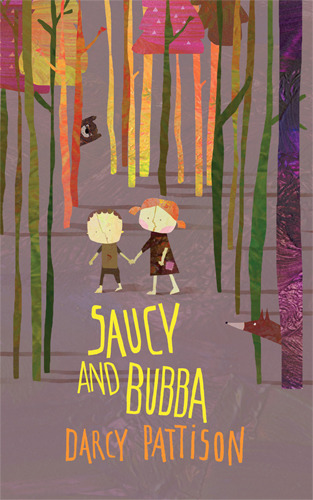
Saucy and Bubba. A Contemporary Hansel and Gretel Story.
I call my recent story, SAUCY AND BUBBA, a contemporary Hansel and Gretel story because it puts it into a certain context: the discussion of step-mothers and how they treat the step-children. Mine is a twist on the old story–of course! In fact, it MUST be a twist on the old story, or it adds nothing to the conversation. Why would you rehash the same thing again. One reviewer said, “When a story can get me to even start to like the antagonist – like Saucy and Bubba does here – I know there’s a good book in my hands.” That’s what I wanted, a more nuanced look at the step-mother. I wanted the reader to have sympathy for her, even as they condemn her actions.It’s like the original Superman comic: in today’s terms, it’s cliched. But it was hugely original for it’s time. It added to the conversations about justice and law-enforcement in interesting ways. If I simply repeated the Hansel and Gretel fairy tale, it would be a flop. Instead, we must think about how our stories fit into the context of our times. We must strive to join the conversation and to have something to add to the conversation. How can we add something different, interesting, conflicting, nuanced and so on? How are you enriching the conversation? How are you changing the conversation?
How does YOUR story join the conversation of our times?


