
Darcy Pattison's Blog, page 13
June 14, 2015
Fowler’s Toad: He Chose Our Pond
The Aliens Inc, Chapter Book Series Try Book 1 for Free
One night In May, I noticed a very loud sound from right outside our window. My husband, Dwight, has a fish pond right outside our kitchen door.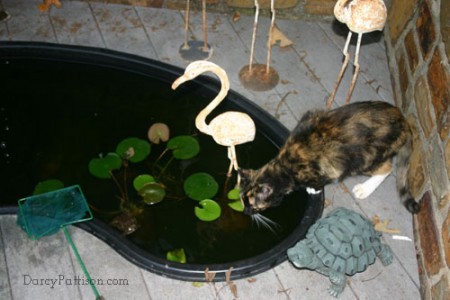 The fish pond is used by our outdoor cat for drinking water.
The sound was loud! So, on May 26, I whipped out my iphone and taped the noise.
http://www.darcypattison.com/notes/wp-content/uploads//20150526-221811.m4a
You’ll hear the noise at 7 seconds into the tape, and 12 seconds, 18 seconds and 23 seconds. The sounds came from a small frog or toad. After comparing my recording to recordings of frogs/toads of Arkansas, I concluded we had a Fowler Toad, which is common in this area.
After reading more, I realized that this toad had chosen our pond as a breeding pond. He chose us! He chose our pond!
As a child, I remember we raised tadpoles once. I was excited about the chance to watch the process again, especially because my grandkids could watch this time.
The toad sang and sang for several nights. All night long, it seemed.
Then, on June 11, I took a morning walk and came back to find two Fowler toads in the pond. The girl showed up!
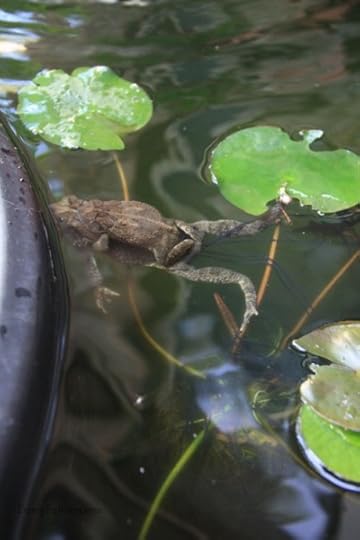
Fowler Toads mate in what’s called amplexus, which means the eggs are externally fertilized. The smaller male is usually on the female’s back for the duration.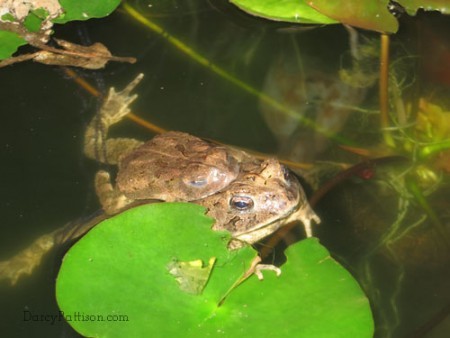 Another view of the couple.
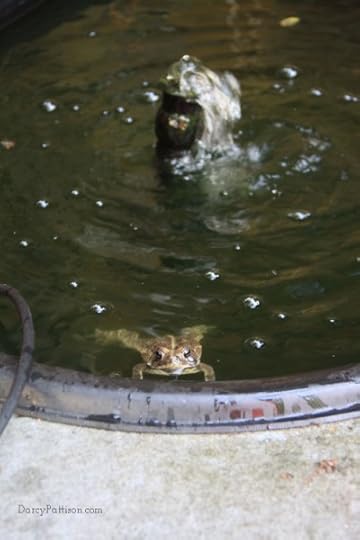 After the mating, the female is trying to find a way out of the slippery sides of the pond. I had to put a fish net on the edge for her to get out. The male hopped out easily.
Tadpoles: Day 3
We watched the pond every day and on Day 3, we found tadpoles! Dozens and dozens. Scientists report that the Fowler Toads may lay 5000-25,000 eggs at a time. But the pond had several goldfish and I knew that many of the eggs would be eaten before they could hatch.
Now, there are dozens and dozens of tadpoles.
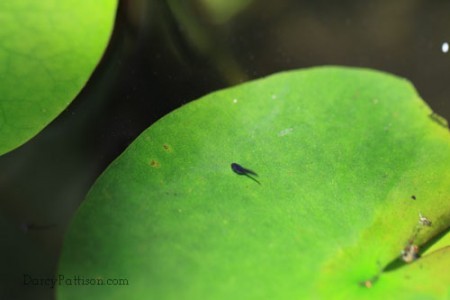 Dozens of tadpoles hatched. However, they are shy and don’t like to be photographed.
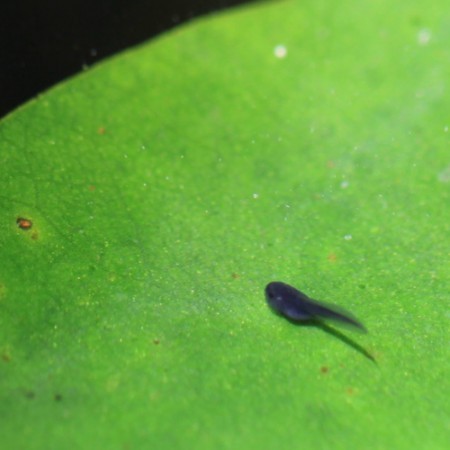 Close-up of the tadpole.
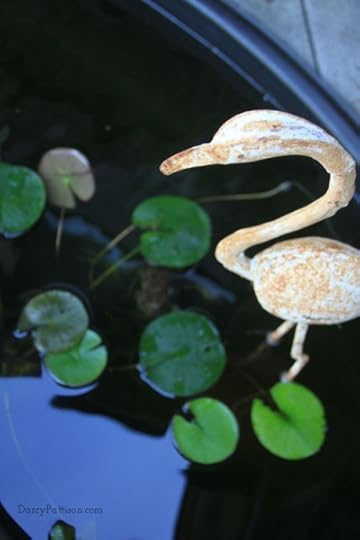 The Flamingo’s eye view of the pond and the toads.
As a person who writes science and nature books for kids, I am always conscious of the possibilities. But this isn’t a book, and may never become one. The story is too common; it’s not ground-breaking science. It’s just fun. And that’s enough.


June 8, 2015
Hope: Send Me Your Good News
The Aliens Inc, Chapter Book Series Try Book 1 for Free
Writers live by hope.
We hope that the next story will break out.
We hope that the next submission will sell.
We hope that the next revision will be amazing.
We hope that the next royalty check will be double.
We hope readers will love our stories.
Hope. It’s how we live. And I love it when Hope comes to live in tangible ways.
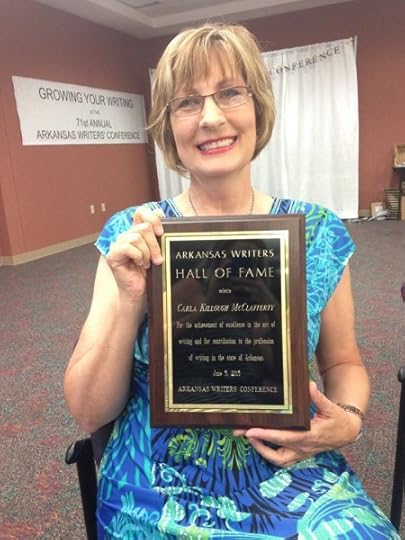 Carla Killough McClafferty, inducted into the Arkansas Writer’s Hall of Fame, June, 2015.
I went Friday to an awards banquet to honor my friend, Carla McClafferty. She was inducted into the Arkansas Writer’s Hall of Fame for her work in children’s non-fiction.
That was hope come to life.
Another Arkansas friend, Cara Brookins had this news reported in today’s Publisher’s Weekly:
Brookins’s ‘Rise’ Goes to SMP
In a six-figure North American rights deal, Rose Hilliard at St. Martin’s Press acquired Cara Brookins’s memoir, Rise. The book, which Dystel and Goderich’s Jessica Papin sold at auction, is about Brookins’s experience as a single mother coming out of an abusive relationship, building her own house from the ground up. SMP said the author, a social media marketing expert in Little Rock, Ark., took on the massive DIY project “with only the help of her four children.” Rise is currently set for fall 2016.
That was hope come to life.
Another Arkansas friend, Monica Clark-Robinson recently sold her first picture book. Here’s the listing on her agent’s site:
Children’s: Picture book: Monica Clark-Robinson’s LET THE CHILDREN MARCH, an historical picture book told from a child’s point of view about the Children’s Crusade, a series of civil rights marches that took place in 1963 to protest the Jim Crow Laws, to Christine Krones at Houghton Mifflin Harcourt Children’s, for publication in Fall 2017.
That was hope come to life.
Each time a friend realizes a small portion of a dream—from the beginning of a career to a career at the top of its game—we need to stop and rejoice with them.
Why? For many reasons—friendship shares good news.
But for today’s purpose, rejoicing over someone’s good news builds my reserve of hope. I know the hope isn’t futile; someone else’s hopes came to fruition and that leaves me with a renewed hope that mine may also.
I often end a speech or a retreat with the words, “Send me your good news.” It’s not hollow words, and it’s not bragging on your part. It’s sharing a joyful event. And really, I’m being selfish: I want my hope recharged.
I often end a speech with: Send me your good news! It builds my reservoir of HOPE! #publishingClick To Tweet
Send me your good news! I want to hear and rejoice with you!
Please add your good news in the comments so we can all rejoice with you.
June 1, 2015
Checklist for Self-publishing a Children’s Picture Book
The Aliens Inc, Chapter Book Series Try Book 1 for Free
Assumption. I am assuming here that you’ve written a fantastic children’s picture book and the illustrations you’ve done or hired done are amazing. You’ve also assembled an amazing book using InDesign (recommended) or other software. This checklist takes up the process at the point where you have the files ready to upload. The checklist is useful whether you are producing a print book or an ebook, although some items may not apply in one or the other cases.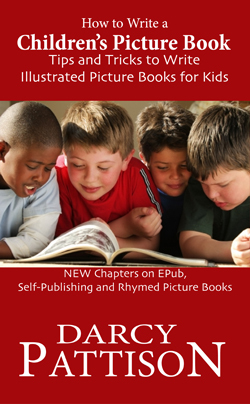
Double-Check the Book’s Production
Front Cover
Double-check spelling of everything.
Color reproduction of the art.
Back cover
Double-check spelling of everything.
Blurbs, quote or promo copy – do you have all the marketing material on the back cover that is needed? Any recent review quotes to add?
Copyright page
(Assumption: you want to sell this book to school libraries. If you only want to sell it as an ebook, then you only need to check the copyright date, since you probably won’t use an ISBN.)
Copyright date correct?
ISBN correct (if used)?
CIP correct? Are you using Publisher’s Cataloging-in-Publication data, which helps librarians catalog your book?
Interior
Check spelling, grammar and punctuation on every page.
Check position and reproduction of art on every page.
(Why are there 32 pages listed?)
p. 1____Text _____Art
p. 2-3____Text _____Art
p. 4-5____Text _____Art
p. 6-7____Text _____Art
p. 8-9____Text _____Art
p. 10-11____Text _____Art
p. 12-13____Text _____Art
p. 14-15____Text _____Art
p. 16-17____Text _____Art
p. 18-19____Text _____Art
p. 20-21____Text _____Art
p. 22-23____Text _____Art
p. 24-25____Text _____Art
p. 26-27____Text _____Art
p. 28-29____Text _____Art
p. 30-31____Text _____Art
p. 32____Text _____Art
Marketing and Metadata Materials
Before you upload files, you’ll need your marketing material ready. I usually create a one-page Sell Sheet that includes the following information.
Exact Title:
Subtitle:
Series Name and Volume of this book:
ISBN, ASIN, and price for each format:
Description
The description is the time to hook your reader. The first 50 characters should give enough information to interest a reader in your book. Limited html is allowed on many platforms, so I often prepare two versions, one plain text and one marked up for html. For Kindle, you have 4000 characters–which is a lot. Use a word processor that counts the number of characters and use all of this valuable real estate.
Categories
Depending on the platform used, you may be asked to provide two or three categories. You can refer to the BISAC categories as a guidelines, but each platform may have its own quirks for this.
1.
2.
3.
Keywords
To help the book buyer find your book, most platforms allow you to insert from 5-7 keywords. You should have these ready; see Amazon’s advice on keywords.
1.
2.
3.
4.
5.
6.
7.
Age Levels
Often a platform will allow you to specify the age range for the book’s audience. Don’t try to cover every age (ages 1-15). Instead, choose a 3-4 year range. Typical ranges are ages 4-8, ages 5-8, ages 6-8, ages 8-12, ages 9-12, ages 12-15, and so on.
File Size
If you plan to publish the ebook on Kindle, you should know the file size. Full color children’s picture books are often 4-8 MGs of data. Because Kindle charges a delivery fee of $0.15 in the US, you’ll want to know this to decide on pricing.
Price for Different Formats
If you upload to multiple platforms, you’ll likely want to be sure to keep the data the same across them. It helps to write out your prices; be sure to update this data whenever you change it on one platform.
Cover Files
While I’m preparing marketing materials, I also like to create multiple versions of my cover files. I label them with the size and the resolution, so it’s easy to find later. Here are typical sizes I create for a square picture book cover, 8.5″ x 8.5″ It’s simple to create multiple files when the Photoshop program is already open, and saves me time later. Usually, I create jpeg files, but sometimes, I’ll repeat for .png files.
Cover-2500×2500-300.jpg (This means the cover is 2500 px by 2500 px at 300 dpi.)
Cover-2500×2500-150.jpg (This means the cover is 2500 px by 2500 px at 150 dpi. Some like to also prepare files at 96 dpi or 72 dpi for use on the web.)
Cover-1000×1000-300.jpg
Cover-1000×1000-150.jpg
Cover-500×500-300.jpg
Cover-500×500-150.jpg
Cover-250×250-300.jpg
Cover-250×250-150.jpg
With the Sell Sheet complete, and the books cover and interior files ready to go, it’s time to upload. Good luck with your book!
May 26, 2015
Beta Readers: Facts, Grammar, Plot, Character and More
The Aliens Inc, Chapter Book Series Try Book 1 for Free
Thanks to the computer industry, we no longer have first readers, we have beta readers. Early versions of software that engineers expect to be riddled with problems were called beta versions. Beta is the second letter in the Greek alphabet, so presumably, the alpha versions were kept all in-house. Betas were the first public versions to be released.
The terminology has come over to writing and we now have beta readers. The analogy holds in some ways: the versions we send to outside readers probably isn’t the “alpha” version; instead, it’s a version that is ready for a public audience—but not ready to be published. We expect problems: typos, grammar slip-ups (Grammar Queens, I Love You!), plot holes, character inconsistencies, factual errors, and so on.
What do you want from your Beta Readers?

Factual details. My WIP is set on Bainbridge Island, which sits in the middle of Puget Sound near Seattle, WA. I’ve visited a couple times because my brother- and sister-in-law live there. However, I’ve not lived there, and I’m not grounded in everything BI. I’ve asked them to read through for factual details related to the setting.
To write this story, I drew on my trips to the area, as well as maps, views from Google Earth, historical accounts of the area, writings about the area, information about the local flora and fauna. I’ve done my homework. But there’s nothing to beat living in the locale for years. I would never have dared to set the story in the area except I knew I had these two gracious beta readers.
Bored. I also asked them to flag places they were bored. Wow! Do I need this one. The overall pacing from chapter-to-chapter, and the local pacing from paragraph-to-paragraph both concern me. I want the story to pull a reader along without a pause. If a beta reader is bored, I need to know. I can fix it, using a variety of tools. I just need to know where to work on it.
Confused. Likewise, if the flow of the story confuses the reader, I need to know. Of course, there may be places you WANT the reader to be confused. I’m not talking about that. I’m looking for places where the reader has no idea what is happening. Again, I can fix it: I don’t want beta readers to suggest HOW to fix it. I just want to know where to pay attention.
Consistency. In characterization, I find my biggest problem is consistency in portraying emotions, motivations, reactions and so on. Part of the process of writing is to find these deeper issues within your character, and for me, I often find them late in the story. That means I have to go back and make sure I’ve set up a motivation and expressed it consistently across the story. And sometimes, I miss something.
While Beta Readers Read
 By: Eran Sandler
This time, I’m trying not to work on the story while the beta readers do their thing. That doesn’t mean I’m not thinking about the story. On the contrary, it’s in the background of my thoughts all the way.
We went to see The Avengers movie last week. If you saw it (SPOILER ALERT), there’s a huge action scene at the end with all the Avengers protecting the explosive device while robots come at them. It’s a great moment because the team has come together and they are working in concert. Besides that character moment, it’s also a huge action scene. And I mean huge. I almost turn away these days at the fast-paced fighting because there is moment after moment of continuous fighting. The last Transformer movie struck me this way, too: when there’s too much action, it deadens the moment for me.
But it also gave me a new perspective on the ending of my story. The hero doesn’t take a big enough part in the action. He is there (hurrah!). He is active (hurrah!). But his parents get in the way. I need to get rid of them and pit him directly against the villain.
In other words, I hit the target with the ending, but it’s not a bulls-eye, yet.
That’s the sort of thing I’m thinking about while the beta readers read. Where have I hit the target, but I’m not hitting the bull’s eye?
I may not be typing words into a program about the story during this time, but I’m working on it. When I get it back, I’ll have a flurry of revisions to do. Isn’t it great?
May 18, 2015
Continuity Goofs: Avengers, Hunger Games and Your Novel
The Aliens Inc, Chapter Book Series Try Book 1 for Free
When my picturebook, The Journey of Oliver K. Woodman was first published, I lied to my mother-in-law. When she saw this image of Tameka writing a letter to her Uncle Ray, my MIL noticed that Tameka was left-handed. I told her that I asked the illustrator, Joe Cepeda especially to make her left handed like my MIL.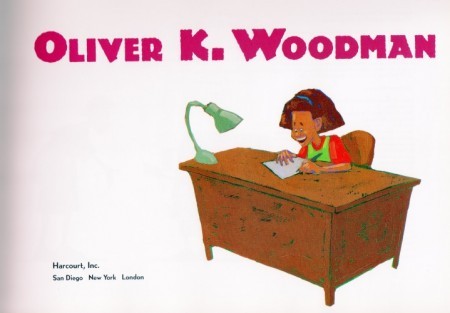
Fast forward to the second book featuring Tameka in search of a wooden woman. Again, Tameka writes a letter, but this time, Cepeda drew her right handed. Because of my lie, I realized immediately that we had a continuity error, and Joe redrew a small portion of the image to make her left-handed again.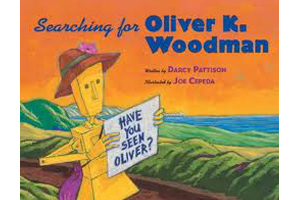
Movies Have Continuity Errors
The Internet Movie Database regularly reports on the errors in movies (look for the “Goofs” link). For instance, for the Hunger Games, the IMDB reports 29 continuity errors. Here are the first three:
When Katniss is turning around to show her fire dress, you can see her hair (bun) comes apart. But in the next scene her hair is nicely tucked in.
When Peeta throws the metal ball at the spears, the career tributes (Cato, Marvel and Clove) are laughing at Peeta before he throws the ball. After Peeta has thrown it, Clove has gone and Glimmer is in her place.
When the 12 chariots are parading to the final stopping spot, the fans are throwing flowers and all kinds of things on the road that they ride in on. When they show the overhead view and the last chariots pull up there is not one item on the roadway.
None of those is earth-shattering; none of those changes the plot; and most wouldn’t be caught by a casual movie-goer. Obsessive people find these things.
For Avengers: Age of Ultron, the IMDB reports five continuity errors – so far. Here are the first two.
Tony’s watch said that it was 12.10 when he axed the logs outside. Then the watch changes into 11.20 when he talked with Fury inside the barn.
After all the Avengers have tried to lift Thor’s hammer, Thor picks it up up with a drink in his hand. In the next shot the drink is on the table.
You would think that after all the efforts from hundreds of people, that a movie would be a bit of perfection. How can these errors slip in? It’s the complexity, I think. When there are so many moving parts, it’s difficult to make sure that everything is in sync with every other part.
Prevent Continuity Errors in Your Novel
One revision I’m doing right now in my novel is for continuity.
Read Your Whole Novel in a Short Amount of Time. Writing a whole novel can take a long period of time, and in that extended time period, you may forget a detail here or there. Were Alice’s eyes blue or green? Is her middle name Elle or Ellen? Reading rapidly for continuity can help refresh your memory.
Create a Character Bible, a Plot Bible, and Story Bible. Some writers like to create a “bible” of sorts. To do this, take a page (or a file, or a Scrivener document) and write the character’s name at the top of the page. Under it, write down the details about that character. Name, age, description, background details, etc. Any time you start to write about the character (or when you go back to check continuity) refer to that page/file. If you write it down, it acts as the “word of God” about the character.
Repeat, as you like for the plot or other story aspects.
Beta Readers Finally, you can find beta readers or critique partners who are sticklers for details like this. Turn them loose and let them go to town.
Whatever you decide, it’s a good idea to do a last read-through for continuity before you send it out to editors. But if you DO miss some small items, you’re in good company with Hunger Games and Avengers: Age of Ultron.
May 13, 2015
Audiofile Reviews Kell, the Alien Audiobook
The Aliens Inc, Chapter Book Series Try Book 1 for Free
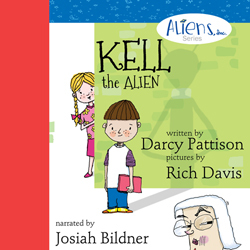
Totally exciting! Audiofile Magazine has reviewed Kell, the Alien, the first book in The Aliens, Inc. Series!
Doing alien voices gives narrator Josiah John Bildner a fun challenge. When the Smith family’s spaceship crashes to Earth, they’re forced to live and talk like Earthlings. Bildner skillfully renders the conversations between Kell, now a third-grader, and his new friend, Bree Hendricks, as Kell learns more about his new home. An audition for the choir’s solo, a moving performance of “My Country ‘Tis of Thee,” stands out. Word misunderstandings between the aliens and Earthlings add chuckles: Is a blow-up spaceship a giant balloon or an explosion? This is a worthy addition to the alien genre for kids. S.G.B. © AudioFile 2015, Portland, Maine [Published: MAY 2015]
Listen to a sample of Kell, the Alien:
http://www.darcypattison.com/notes/wp-content/uploads//9781629440477-sample.mp3
BOOK 1: Kell,the Alien
BOOK 2: Kell and the Horse Apple Parade
BOOK 3: Kell and the Giants
BOOK 4: Kell and the Detectives
May 4, 2015
Ban Cliches: How to Stand Out in Today’s Crowded Market
The Aliens Inc, Chapter Book Series Try Book 1 for Free
The number one rejection I hear is this: “The story doesn’t stand out in today’s crowded market.”
The SCBWI is creating an opportunity for illustrators to test their art and how it holds up in today’s market. Each month, the “Draw This” monthly art prompt will provide a word for members to illustrate.
For years I’ve followed a similar type experience at IllustrationFriday.com. They, too, provide an art prompt of a word. In looking through the weekly images, I started to understand the concept of “standing out.” For example, one week, the word was RED. Looking through, I saw the same images: firetrucks, little red wagons, red-headed girls, Little Red Riding Hood, gorgeous cardinals, and so on. Those who illustrated the prompt with such an obvious cliche probably thought they were showcasing their work. Instead, I thought they were showcasing their lack of creativity.
2009 World Beard and Mustache Competition. Does that beard spell out B-E-A-R-D?
Here are the images for an Illustration Friday prompt, Beard. Now look through Beard images on Flickr. Or look through the BeardBrand shop and see how their photographers captured the young urban male and his passion for beards. Which is more exciting and fresh? Are these cliched images? No!
Writers, you can play along, too! Take the illustration prompt as a writing prompt. List your first 10 ideas–and throw them out. Those are the cliched ideas. Now, write 10 more ideas. Choose the strongest and write a story that has a fighting chance of standing out in today’s crowded market.
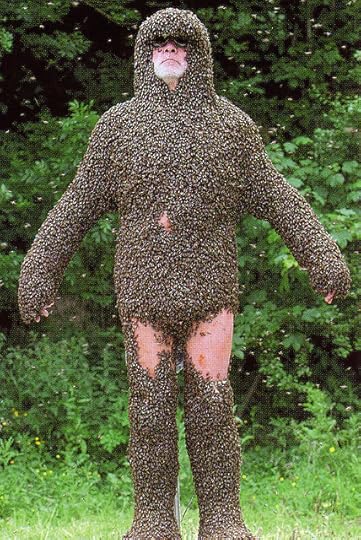
I’ve never seen a Bee-Beard before. Have you?
The SCBWI “Draw This” June prompt: Bounce
Illustrations due by May 25. See full rules here. While the prompt is only open to SCBWI members, anyone can play along!
April 29, 2015
Top 20 YA Agents: 142 Sales in the Last 12 Months
The Aliens Inc, Chapter Book Series Try Book 1 for Free
What agents are selling young adult (YA) novels? Publishersmarketplace.com does a great job of monitoring the business of selling manuscripts to publishers. If you’re looking for an agent, you’ll want to spend a lot of time there doing research on agents to find the perfect match for you and your stories. Here’s just one way to look at the agents for young adult novels. This list includes information on the agent, links to his/her agency and the number of young adult deals made in the last twelve months. Please note that the agent/agency may have made many other deals in addition to these; these are limited to those self-reported by the agent/agency in the category of middle grade. For more information, go to Publishersmarketplace.com (you must pay to join to see full information).
This is the last of three articles on current agents for children’s books. See also Picture Book Agents and Middle Grade agents lists.
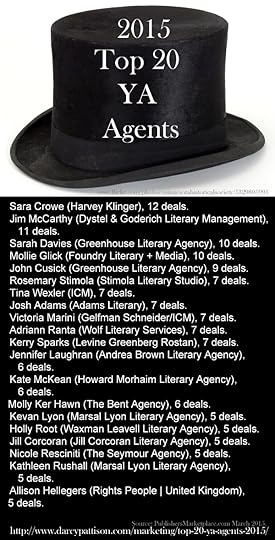
I did a similar report on YA agents in 2013. At that time, I only listed the top 10 YA agents, who represented 72 deals. This time, the top 10 agents report 85 sales. This could be due to a couple reasons: first, Publisher’s Marketplace relies on agents to self-report. This means that the agents are, for the first time, in a sort of competition for rankings. Reporting more sales means they are ranked higher, which gives prestige and possibly brings in more prospective clients. Second, it could mean that sales are up for picture books. We hope the latter is the case, but suspect the first reason has much to do with the increased number of sales.
Sara Crowe (Harvey Klinger), 12 deals. Website
Jim McCarthy (Dystel & Goderich Literary Management), 11 deals. Website
Sarah Davies (Greenhouse Literary Agency), 10 deals. Website
Mollie Glick (Foundry Literary + Media), 10 deals. Website
John Cusick (Greenhouse Literary Agency), 9 deals. Website
Rosemary Stimola (Stimola Literary Studio), 7 deals. Website
Tina Wexler (ICM), 7 deals. Website
Josh Adams (Adams Literary), 7 deals. Website
Victoria Marini (Gelfman Schneider/ICM), 7 deals. Website
Adriann Ranta (Wolf Literary Services), 7 deals. Website
Kerry Sparks (Levine Greenberg Rostan), 7 deals. Website
Jennifer Laughran (Andrea Brown Literary Agency), 6 deals. Website
Kate McKean (Howard Morhaim Literary Agency), 6 deals. Website
Molly Ker Hawn (The Bent Agency), 6 deals. Website
Kevan Lyon (Marsal Lyon Literary Agency), 5 deals. Website
Holly Root (Waxman Leavell Literary Agency), 5 deals. Website
Jill Corcoran (Jill Corcoran Literary Agency), 5 deals. Website
Nicole Resciniti (The Seymour Agency), 5 deals. Website
Kathleen Rushall (Marsal Lyon Literary Agency), 5 deals. Website
Allison Hellegers (Rights People | United Kingdom), 5 deals. Website
April 27, 2015
Top 20 Middle Grade Agents: 129 Sales in the Last 12 Months
The Aliens Inc, Chapter Book Series Try Book 1 for Free
What agents are selling middle grade novels? Publishersmarketplace.com does a great job of monitoring the business of selling manuscripts to publishers. If you’re looking for an agent, you’ll want to spend a lot of time there doing research on agents to find the perfect match for you and your stories. Here’s just one way to look at the agents for middle grade novels. This list includes information on the agent, links to his/her agency and the number of middle grade deals made in the last twelve months. Please note that the agent/agency may have made many other deals in addition to these; these are limited to those self-reported by the agent/agency in the category of middle grade. For more information, go to Publishersmarketplace.com (you must pay to join to see full information).
This is the second of three articles on current agents for children’s books. See also Picture Book Agents and YA Agents lists (link is live on 4/29).
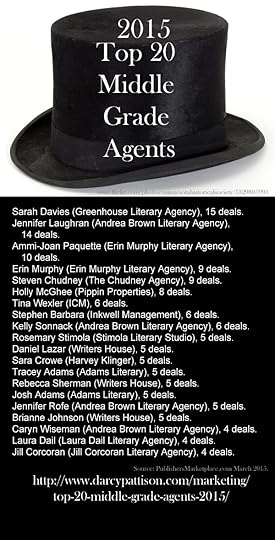
I did this roundup of middle grade agents in 2013 and you may want to compare the list from then. At that time, I only listed the top 10 agents, who represented 60 sales. This time, the top 10 middle grade agents report 80 sales. There may be two reasons for this. First, Publisher’s Marketplace relies on agents to self-report. This means that the agents are, for the first time, in a sort of competition for rankings. Reporting more sales means they are ranked higher, which gives prestige and possibly brings in more prospective clients. Second, it could mean that sales are up for middle grade novels. We hope the latter is the case, but suspect the first reason has much to do with the increased number of sales.
Sarah Davies (Greenhouse Literary Agency), 15 deals. Website
Jennifer Laughran (Andrea Brown Literary Agency), 14 deals. Website
Ammi-Joan Paquette (Erin Murphy Literary Agency), 10 deals. Website
Erin Murphy (Erin Murphy Literary Agency), 9 deals. Website
Steven Chudney (The Chudney Agency), 9 deals. Website
Holly McGhee (Pippin Properties), 8 deals. Website
Tina Wexler (ICM), 6 deals. Website
Stephen Barbara (Inkwell Management), 6 deals. Website
Kelly Sonnack (Andrea Brown Literary Agency), 6 deals. Website
Rosemary Stimola (Stimola Literary Studio), 5 deals. Website
Daniel Lazar (Writers House), 5 deals. Website
Sara Crowe (Harvey Klinger), 5 deals. Website
Tracey Adams (Adams Literary), 5 deals. Website
Rebecca Sherman (Writers House), 5 deals. Website
Josh Adams (Adams Literary), 5 deals. Website
Jennifer Rofe (Andrea Brown Literary Agency), 5 deals. Website
Brianne Johnson (Writers House), 5 deals. Website
Caryn Wiseman (Andrea Brown Literary Agency), 4 deals. Website
Laura Dail (Laura Dail Literary Agency), 4 deals. Website
Jill Corcoran (Jill Corcoran Literary Agency), 4 deals. Website
April 22, 2015
Top 20 Picture Book Agents: 234 Sales in the Last 12 Months
The Aliens Inc, Chapter Book Series Try Book 1 for Free
What agents are selling picture books? Publishersmarketplace.com does a great job of monitoring the business of selling manuscripts to publishers. If you’re looking for an agent, you’ll want to spend a lot of time there doing research on agents to find the perfect match for you and your stories. Here’s just one way to look at the agents for picture books. This list includes information on the agent, links to his/her agency and the number of picture book deals made in the last twelve months. Please note that the agent/agency may have made many other deals in addition to these; these are limited to those self-reported by the agent/agency in the category of picture books. For more information, go to Publishersmarketplace.com (you must pay to join to see full information).
This is the first of three articles on current agents for children’s books. See also Middle Grade Agents and YA Agents lists (Links will be live next week).
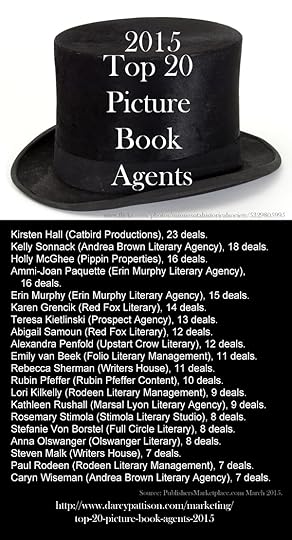
Interesting, when I did this in 2013, the top 20 picture book agents had reported 171 sales. This time, the top 20 agents are reporting 234 sales. This could be due to a couple reasons: first, Publisher’s Marketplace relies on agents to self-report. This means that the agents are, for the first time, in a sort of competition for rankings. Reporting more sales means they are ranked higher, which gives prestige and possibly brings in more prospective clients. Second, it could mean that sales are up for picture books. We hope the latter is the case, but suspect the first reason has much to do with the increased number of sales.
Kirsten Hall (Catbird Productions), 23 deals. Website.
Kelly Sonnack (Andrea Brown Literary Agency), 18 deals. Website
Holly McGhee (Pippin Properties), 16 deals. Website
Ammi-Joan Paquette (Erin Murphy Literary Agency), 16 deals. Website
Erin Murphy (Erin Murphy Literary Agency), 15 deals. Website
Karen Grencik (Red Fox Literary), 14 deals. Website
Teresa Kietlinski (Prospect Agency), 13 deals. Website
Abigail Samoun (Red Fox Literary), 12 deals. Website
Alexandra Penfold (Upstart Crow Literary), 12 deals. Website
Emily van Beek (Folio Literary Management), 11 deals. Website
Rebecca Sherman (Writers House), 11 deals. Website
Rubin Pfeffer (Rubin Pfeffer Content), 10 deals. Website
Lori Kilkelly (Rodeen Literary Management), 9 deals. Website
Kathleen Rushall (Marsal Lyon Literary Agency), 9 deals. Website
Rosemary Stimola (Stimola Literary Studio), 8 deals. Website
Stefanie Von Borstel (Full Circle Literary), 8 deals. Website
Anna Olswanger (Olswanger Literary), 8 deals. Website
Steven Malk (Writers House), 7 deals. Website
Paul Rodeen (Rodeen Literary Management), 7 deals. Website
Caryn Wiseman (Andrea Brown Literary Agency), 7 deals. Website


