
Darcy Pattison's Blog, page 12
August 10, 2015
Copyediting: Style Manual for Your Story
Here’s a question about punctuation, with an answer about style.
Which of these is correctly punctuated?
I like oranges, apples, and bananas.
I like oranges, apples and bananas.
The answer is it depends on the style manual that you use.
In school, you were probably taught certain rules about punctuation, and your teachers told you that the rules were the “right” way to punctuate. There were no options, no other ways of working.
The reality is that punctuation conventions are just conventions that people agree upon. Two major style guides ar the Associated Press style guide, which is often used by newspapers, and the Chicago Manual of Style, often used by publishers. To make matters more complicated, often a publishing house will follow a “house style,” that is, they will decide that all of their books will follow certain punctuation rules.
In the example above, the AP style would add that last comma, but the Chicago style wouldn’t.
I like oranges, apples, and bananas. (AP Style)
I like oranges, apples and bananas. (Chicago Manual of Style)
When my first book was published by Grennwillow/Harpercollins, of course, it went through extensive editing. I was shocked and embarrassed by the red ink that came back to me on the edited manuscript. In truth, I didn’t do so badly. They were simply applying the house style to my story. Copyeditors use a style manual as they edit.
Copyedit According to Style
What does this mean for your story? Well, you have options.
First, you could just write the best story you know how, copyedit the best you know how–and then trust your publisher’s copyeditor to finish the process. It works.
Or, you could study one of the style manuals and stick with it strictly. For fiction, the best option is probably the Chicago Manual of Style. Learning a style guide down cold is technical stuff, and takes focus and an eye for detail; but it can be done.
If you’re self-publishing, you can still choose one way or the other; the difference is that you’ll be hiring the copyeditor and will tell them what style to use.
Personally, I’ll admit it: I don’t have an eye for detail necessary to be a good copyeditor. It would be painful for me to strictly follow a style manual. With each story, I learn more and more about things I should or shouldn’t do; however, I’ll never be perfect. Well, no one will be perfect–see this post on continuity goofs and other errors. But a good copyeditor can get your story pretty close to perfect. I let them do what they do best while I do what I do best, which is to tell a story.
Be very sure: that’s not a copout. I’m not ignoring the issue of punctuation. Writers should take it seriously and know the basics and know when and how they can stretch the punctuation. One of my favorite books for learning basic punctuation is The Art of Styling Sentences: 20 Patterns for Success. Grab a friend and learn a new sentence pattern every week for twenty weeks. Practice the pattern that week by using it in emails back and forth, or in postings on FB or your fav social media channel.
I will always value a good copyeditor! If you’re a grammar witch–I love you! (Just don’t email me about any mistakes in this post.)


August 3, 2015
Is Your Manuscript Ready to Submit? The Agony of Deciding
A fellow writer recently posed this question to me: Is my mss ready to submit?
THE AGONY OF DECIDING
The short answer is, you don’t know. You can only send it out and see what response you get. That’s agony. You want to be accepted and published, but no one can guarantee that. The simple fact is that manuscripts that sit on a hard drive somewhere will not sell. Even if I said your book is “perfect,” it may not sell. You must test the market and learn from every submission.
Here are things to consider as you decide on submission:
Have you done the best job that you know how to do right now? The best you can do at any give time is the best you can do. Don’t send out your weakest effort. But if you’ve worked hard on the story and it’s the best you know to do, then send it. Hope for a sale, but rejoice if you get any feedback at all. That’s what you want: useful feedback. Sometimes a casual comment will trigger a huge change in a story.
Trust your instincts. Too often writers spend years in revision. One attitude the indie revolution has built is that you should trust your instincts, write fast (because time IS money), and get books out. It’s something that traditionally published writers can learn from. You’re a storyteller: trust your instincts.
Do a couple trial submissions. Nothing says that you must send the story first to a hundred agents or editors. Even agents do trial submissions. They’ll often send to a limited number of editors and see what feedback they get. Granted, they GET feedback and you may not. Based on editorial response, the agent may ask a client to revise, or they may do a wider or a different submission strategy.
Consider individual preferences. In other words, your audience in submitting is an individual editor, one by one. One editor said it’s like this. If he likes pullover sweaters–a personal preference–and you sent him the most luxurious button-up sweater ever made, he still wouldn’t buy it because he only likes pullovers. The key, then, is to find the right agent/editor. The only way to do that is to follow likely candidates on Twitter, FB, etc. and see how the conversations go. Then–heck, just submit! You can always revise and resubmit a year later to the same editor, if needed. Go to conferences and get feedback from critiques there.
In the end, I write for an audience. I want to put my book in the hands of the RIGHT readers, whether that’s a kid from Wisconsin, or an editor or agent in New York City. In the end, at some point, you must submit. Or face the fact that you’ll never be published. It’s a painful truth, a painful process. But it’s part of the game. Submit! Today!
Is Your Manuscript is Ready to Submit? The Agony of Deciding
A fellow writer recently posed this question to me: Is my mss ready to submit?
THE AGONY OF DECIDING
The short answer is, you don’t know. You can only send it out and see what response you get. That’s agony. You want to be accepted and published, but no one can guarantee that. The simple fact is that manuscripts that sit on a hard drive somewhere will not sell. Even if I said your book is “perfect,” it may not sell. You must test the market and learn from every submission.
Here are things to consider as you decide on submission:
Have you done the best job that you know how to do right now? The best you can do at any give time is the best you can do. Don’t send out your weakest effort. But if you’ve worked hard on the story and it’s the best you know to do, then send it. Hope for a sale, but rejoice if you get any feedback at all. That’s what you want: useful feedback. Sometimes a casual comment will trigger a huge change in a story.
Trust your instincts. Too often writers spend years in revision. One attitude the indie revolution has built is that you should trust your instincts, write fast (because time IS money), and get books out. It’s something that traditionally published writers can learn from. You’re a storyteller: trust your instincts.
Do a couple trial submissions. Nothing says that you must send the story first to a hundred agents or editors. Even agents do trial submissions. They’ll often send to a limited number of editors and see what feedback they get. Granted, they GET feedback and you may not. Based on editorial response, the agent may ask a client to revise, or they may do a wider or a different submission strategy.
Consider individual preferences. In other words, your audience in submitting is an individual editor, one by one. One editor said it’s like this. If he likes pullover sweaters–a personal preference–and you sent him the most luxurious button-up sweater ever made, he still wouldn’t buy it because he only likes pullovers. The key, then, is to find the right agent/editor. The only way to do that is to follow likely candidates on Twitter, FB, etc. and see how the conversations go. Then–heck, just submit! You can always revise and resubmit a year later to the same editor, if needed. Go to conferences and get feedback from critiques there.
In the end, I write for an audience. I want to put my book in the hands of the RIGHT readers, whether that’s a kid from Wisconsin, or an editor or agent in New York City. In the end, at some point, you must submit. Or face the fact that you’ll never be published. It’s a painful truth, a painful process. But it’s part of the game. Submit! Today!
July 30, 2015
An Incredible Signature: Thanks, Marcia and Sergio!
As writers, we put our books out into the world, and they take on a life of their own, apart from us. But sometimes, we get an echo back about what the book is doing, who is reading it and how they are affected. This week, I had one of those incredible, amazing and powerful moments.
Abayomi, the Brazilian Puma
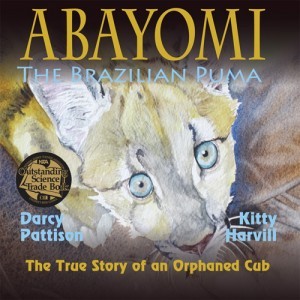
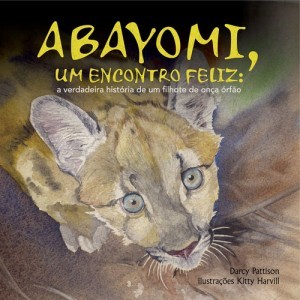
When I worked on the story of an orphaned puma cub from Brazil, the scientists involved were incredibly generous with their time and information. Dr. Marcia Goncalves Rodrigues and Sergio A.P. Ferreira made this book possible. With the publication of the Brazilian translation, they are able to go into the schools with Project Abayomi and do education of teachers and students. Recently, over 500 teachers listened the story of the plight of pumas and other wildlife in urban areas of Brazil.
That’s exciting news, for sure. To see a book travel to a different country and start to make a difference is amazing.
And then, I received this special version of the Portuguese version of the book. What’s so special about it? Why am I grinning so crazily?
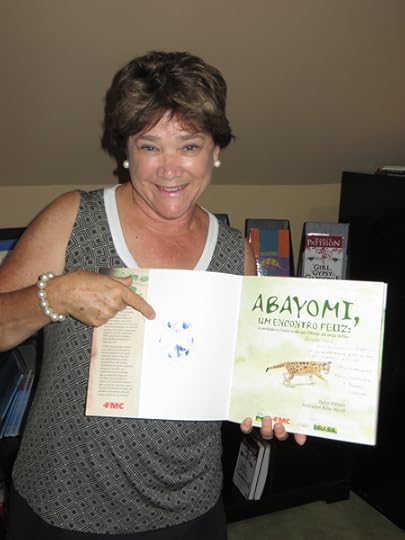 This book was signed by Abayomi himself. That’s his paw print. Thanks, Marcia and Sergio for allowing me to be part of Abayomi’s story.
Because Abayomi himself signed this book. When the puma was receiving a regular medical checkup, Sergio inked his paw and added his paw print to my book. This is one of those teary moments when you realize that a book isn’t JUST a book. It’s an idea. Pumas face very real dangers from loss of habitat and urban encroachment on their habitat. It’a a small thing to write a book; but a small book can have a huge impact. Thanks, Marcia and Sergio for allowing me the privilege of having a small part in Abayomi’s story. It’s been incredible.
Read More about the Brazilian Corridor Project for Pumas
July 27, 2015
Author Website: Getting Started
One of the more popular series I’ve written is 30 Days to a Stronger Author Website. It breaks the process of creating an author website and blog into a series of daily tasks. Theory covers the WHY, WHEN, and HOW. Technical aspects are covered in depth. More important, it gives solid reasons for WHAT, or the content of your site. Learn what readers want on each of these pages: Home, About, Books, News, Contact, Privacy. Get ideas on how to write your first 15 blog posts.
But first you need a site.

This post will lay out a clear, simple, 15-minute process for starting your website, with lots of visuals. For other details, read the 30 Days to a Stronger Author Website series.
Some of the links below are affiliate links, meaning, at no additional cost to you, I will earn a commission if you choose to make a purchase. Thank you for your support in this way.
1) Hosting
First, you’ll need to decide where to host your website/blog, or where your computer files will actually live on a server. While some opt for free services, I’ve had a self-hosted WordPress site/blog for over seven years and love the freedom of doing whatever I want on my own site. I don’t have to worry about the terms of service, because I create my own policies.
While there are multiple options for hosting, one of the most popular is Blue Host, which I recommend because of its simplicity and reliability.
Click here to go to BlueHost. This opens a new window so you can go back and forth on the instructions here.
Click the green GET STARTED NOW button.
Next, you’ll need to choose a plan. All of BlueHost’s plans come with one free domain, so there’s not an extra step for registering that–it’s a one-stop service.

2) Choose a Domain
Authors, you should use your name or pen name for your domain. And get a .com if at all possible. This website is DarcyPattison.com. Sometimes, you may want to create a website for a book, so you can use a book title, if desired. But the gold standard is your name.
If you already have a domain, BlueHost makes it simple to switch over; just use the Transfer Domain box.

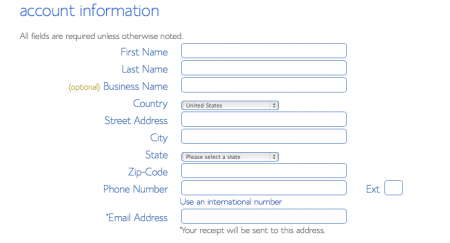
You’re almost there. Fill in the form with contact info. Make sure the email is working because that’s where you’ll receive information about how to login.
3) Hosting Package
You have a choice now of hosting packages. I’m always amazed at the affordability of a self-hosted package.

I rarely add on any of the extras. Some people like the privacy option, but I’ve never found it necessary.
Of course, it’s time to fill in your billing information. Read the Terms of Service and policies and confirm. Then click NEXT.
You’ll be asked if you want upgrade; I usually skip all these. You can always add things later, if you need something. Instead, skip over to your email and find the welcome email from BlueHost. It’s time to look at your dashboard or the backend of your site. Most hosting companies use a CPanel. You’ll want to read more later on CPanel basics, but for now, we’ll cover how to install your WordPress site.
4) Install WordPress
Go back to BlueHost and Click LOGIN at the top.

Use the info you received in your welcome email to login.
At first the CPanel can look overwhelming (read more on CPanels here), but we just need to install the WordPress that’s listed under Website Builders.
Click on the green START button.
Click on the website where you want to install the WordPress blog. Usually, you leave the directory blank.

Your WordPress user information is important. Do NOT use ADMIN. This will be your login information for the site, so create this with care. Click on the Advanced Options and fill in your site information. Don’t worry: you can always change this later. The admin email is also important because this is where you’ll get emails about the site. When you’re sure everything is correct, click Install Now.
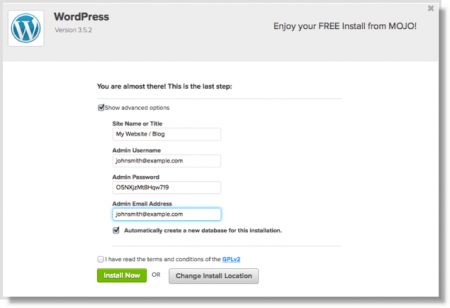
You should see a “SUCCESS” status. Wahoo!
5) Log in to Your Author Website!
You should receive an email with login instructions. Basically, you’ll go to www.YourWebsite.com/wp-admin/login (Replace YourWebsite with the name of your site).
Now, the fun really begins. It’s time to create some content and get your site/blog going.

First, you’ll want to customize your WordPress installation, develop the functionality of the site with plugins, and choose a theme that governs how it looks.
No worries! The 30 Days to an Author Website series will walk you through the next few days!
July 15, 2015
10% of My Referral Traffic Comes From Pinterest: Expand Your Author Platform
Abayomi Launches in Brazil
Click cover to see the photo gallery.
Note: On Jane Friedman’s blog, you can read my guest post about a unique Pinterest project. I’ve pinned the entire picture book, I WANT A DOG, to Pinterest as a preview of the book. Read the reasons and how-to’s here.
Social media–what a controversial topic among writers!
You have the social media mavens, who are everywhere on every platform.
And you have those who espouse the WIBBOW test: “Would I be better off writing?”
You’ve decided that you want to raise your social media profile as an author. There are a couple compelling reasons to turn to Pinterest. Yes, Pinterest. I like the way my daughter, Sara, describes the difference in Pinterest and Facebook. She says to look at Facebook to see what she’s DOING; look to Pinterest to see what she’s THINKING about. Other say that Pinterest is aspirational, which means these are things the pinner would like to do. She’d like to decorate her house like this, would like to get this haircut–or would like to read this book.
 This image was created on Canva for this post.
Your audience is there. Known to be an audience of 80% women, Pinterest is a playground for women on a number of topics: Food & Drink, DIY & Crafts, Home Decor, and Holiday & Events. Photos of interest can be repinned thousands of times–which puts the image in front of many viewers. For example, the image for this Fiction Notes post about villains has been repinned over 19,000 times. Check the widget in the sidebar to see other popular posts on Fiction Notes. (And hey, we always love more repins!)
You have book covers–which fits the visual medium of Pinterest. Images rule on Pinterest, just like they do for book covers. It’s a natural fit.
Pinterest can become one of the best sources of traffic for your website. I recently looked at my website statistics. I’d been beating the Facebook drum, trying to find an audience; instead, Pinterest referrals had quietly racked up 10% of my overall traffic. For some pages, the percentage is much higher, like the villains post mentioned above. That woke me up; if I was just casually playing with Pinterest and could manage 10% referrals, what could happen if I concentrated on the platform?
Pins keep on giving: repins give your content new life, over and over and over again. You Pin an image to a board on Pinterest. Then, someone sees the image and re-pins it to one of their boards. From that board, it gets repinned; and the process can continue. Pinterest likes to say that, “Pins are forever.” You may pin something this week that gets ignored; but something might revive it in three months or six months–perhaps an appropriate event or current news event. A pin can take off at any time and go viral.
Getting Started
I’m going to collect below some other posts on the basics of Pinterest. If you know nothing at all, this article explains the way the platform works. Once you understand that, there are two basic rules for authors:
Get a Business Account. As an author building a platform, you need access to the goodies available on a business account. You’ll be able to promote pins, create rich pins and much more. Follow Pinterest’s instructions here.
Fill in Every Blank.
YOUR PROFILE. When you set up a social media account, you’ll need to fill in a profile. Please do yourself a favor: fill in every blank possible. The platform didn’t put that data slot there for nothing. They USE the data to help people find you. You want to reach the right audience with the right message, and it’s impossible for the platform to send you those folks if you don’t help them out. They aren’t mind-readers.
YOUR IMAGES ON PINTEREST. Likewise, you’ll need to start paying attention to the metadata (data about the data) for your images. When you load an image onto your website, fill in every blank. The Caption is the only thing optional. And make sure the data you use is useful. For photos, there are three blanks: Title, Alt Text, Description.
IF you have all three filled in, Pinterest will pull in the Alt Text as the description of the image. If there’s no description or alt text, it will use the title of the image as the description.
When uploading an image, the title defaults to the name of your file. So, if your photo is named 123XX.jpg, then the Title will default to 123XXX. Bad news for you on Pinterest. Every time someone repins your image, the description will read 123XXX.
Instead, create a description (500 characters or less) and Copy/Paste that into all three fields. I find that’s the easiest, to just repeat the info over an over. If at some point, Pinterest (or another social media platform) decides to use a different field, I’ll have the description in place.
Finally, you can always manually edit the metadata when you pin/repin. It’s just easier to take care of it upfront.
Comparing the different social media platforms:
Instagram: square images (1:1 ratio), hashtags are the metadata.
YouTube: horizontal images (16:9 ratio). If you’re shooting still images to add to a video slideshow, always shoot horizontal.
Pinterest: vertical images (4:6 ratio), metadata comes from the image’s original upload, or it’s manually edited.
Creating Great Images
This means that you should know where you plan to use images when you create them. My favorite place for editing images for Pinterest is Canva.com. Use their Pinterest template to get the size right; upload your own images or buy one of theirs for only $1; edit as needed. For more, see below.
Links to Tutorials for Pinterest
You’ll find tons of tutorials and classes to help you get up to speed on this platform. Like all social media channels, best practices change often as a platform adds new tools, policies, etc. Be sure to look for recent material.
A simple guide to understanding Pinterest, from Pinterest.
Constant Contact has 10 Things to Consider when you get started, including what name to use for your profile and your boards.
Sign up for an business account, not a personal account. Pinterest’s HELP on Getting Started.
Listen to an “Oh, So Pinteresting podcast” for current best-practices for your profile and boards.
A New Look at Your Pinterest Account OSP 080
Canva’s Guide to creating a consistent brand is great. Here’s a short post that summarizes the info, but here’s a free ebook that goes into more detail (You must sign up for their newsletter to get this.)
Which social media platform do you like best? No. Which brings you the most results: the most referral traffic, the most sales, the most followers, etc.?
July 13, 2015
8 Most Popular Writing Books with Our Readers
Abayomi Launches in Brazil
Click cover to see the photo gallery.
From time to time, we recommend writing books, and we find that some are popular with our readers. Following are the most popular how-to-write books purchased by our readers in the last six months on Amazon, the first half of 2015*.
Action! Writing Better Action with Cinematic Techniques

Certainly one of my favorite new writing books is Ian Healy’s excellent book on writing action scenes. Before I read it, my action scenes were awful. Now, my latest novel has effective action scenes sprinkled throughout. Thanks, Ian! Be sure to also download the Action Scene Checklist that I created, with Ian’s permission. This was the most popular book, by far.
Start Your Novel: Six Winning Steps Toward a Compelling Opening Line, Scene and Chapter
* Note: these lists were compiled from reports supplied to us from Amazon.com where we are affiliates. One of the ways Fiction Notes is able to cover its costs and be a sustainable business is that we earn a small commission when readers make a purchase from Amazon after clicking on our links (including those above). While no personal details are passed on we do get an overall report from Amazon about what was bought and are able to create this list.
July 6, 2015
What’s in Your Writer’s Bag of Tricks? Putting the Writing Process in Context
Abayomi Launches in Brazil
Click cover to see the photo gallery.
I’m in the middle of a big revision of the first book of a sff trilogy and I thought I knew what to do. I’ve written several novels now and when I get to this stage, there’s one big problem. I am sick of reading the thing.
How many times do you read a novel before you send it out into the world? 5 times? 20 times? 100 times? I don’t know; I just know that it’s a lot of times and it reaches a point where I’m not re-reading what’s in front of me. My mind wanders off to anything and everything else.
One strategy I’ve used to deal with that is to retype the entire manuscript. Even if it’s 60,000 words, I just dig in and retype. This strategy forces me to see every word anew. It’s a strategy that I know works.
Except, it didn’t this time. I kept putting off the typing. When it was time to start, I’d find something some marketing to do; or I’d read on my Kindle; or I’d do research for a different project. I forced myself to type out about 25,000/60,000 words, but I was making very few changes. I wasn’t confident that this strategy was working.
Finally–with the urging of a friend–I stopped the foolishness. I started copying one chapter at a time into the fresh document and working on just that chapter till all issues were resolved.
Wow! I’ve totally revamped a scene: it was static with no tension and needed lots of work. I found a conflict sitting there amidst the rubble, picked it up and ran with it. I cut a scene totally–worthless dialogue that went nowhere. Another scene got an overhaul for emotional impact.
In other words, my process is different for this book than for all previous books. Duh. Of course.
Each book that I write, I find a different way to work.
What doesn’t change are techniques that I have in my writer’s bag of tricks. I just need to remember that I won’t be using them in the same order for each book. Also, I may not use every technique or tip for every novel. And that there are always shiny new ways of working to explore, and that’s OK. Retyping a manuscript is a great technique that I’ll likely use again, even though it was deadly for this one. Focusing on short chapters this time helped me to see the story in a context that allowed for good decision making. That’s what you want: good decision making in your storytelling.
Stuck? Rummage around in your writer’s bag of tricks and try something different!
June 22, 2015
4 Revision Goals: Conflict, Emotion, Surprise, Enrich
Abayomi Launches in Brazil
Click cover to see the photo gallery.
For the next month, my writing goals for my work-in-progress novel trilogy are clear: conflict, emotion, surprise, enrich.
The trilogy is tentatively called, The Blue Planets, and is an early-teen or YA science fiction. Book 1, The Blue Marble, has a complete draft; for Books 2 and 3, I have complete outlines. I’m happy with all of it, but I know it needs to go much farther before anyone sees it. For the next month, I’ll work simultaneously on revising Book 1 and the outlines, trying to weave them into a more coherent whole.
4 Revision Goals
Conflict. The first goal in revising The Blue Planets is to up the conflict.
No conflict = no story, no readers.
Small conflict = small readership.
Big conflict = bigger readership.
Huge, gut-wrenching, moral-decison-making conflict = huge, engaged readership.
I’ll be looking at conflict globally and in each scene. Man v. nature is built into the story in powerful ways already. But I need to look at man v. man, both overall and in each scene. How can I put people at odds in more ways and in more interesting ways?
Emotion. Always my weakest point, I’ll go scene by scene and ask questions:
What emotional things happened just before this scene? What’s the attitude of each character coming in?
What is the worst thing–emotionally–that could happen to the main character? That’s what I must confront him with.
What is the emotional arc of the scene?
What else can I do to deepen the emotional impact?
Surprise. Readers read for entertainment. If they can predict exactly what happens in a story, they’re bored. I’ll go through–especially the outlines–and ask, “What does the reader expect here?” I’ll look for ways to twist that expectation to fulfill it, but with a twist.
Enrich. I’m excited about enriching the stories, because this part gets past the basic plotting and into fun stuff. Where can I add humor? Here are previous posts on 3 humor techniques and then 5 more. I’m hoping for a running gag, at least. I’ll be working to tie the three books together through scene, character, bits of dialogue, running gags, perhaps a bit of clothing, or a mug of triple-shot venti mocha–something. Enrichment might be adding bits of scientific information artfully, without doing an information dump. Making the characters quirkier and more fun to be around. Loosening up on dialogue.
By the middle to end of July, I expect the BLUES to be in shape to send out. I’m excited.
What are your goals for summer writing?
June 15, 2015
Find Your Novel Opening: Quickly, Efficiently–and with MORE Creativity
The Aliens Inc, Chapter Book Series Try Book 1 for Free
I’ve been fiddling with the opening of the second book of a trilogy, Blue Planets, for several weeks, trying to plot, trying to think of new and exciting ways to tell the story. I KNOW the story. It’s bringing it down to specifics that’s hard.
Part of my problem is that Book 1 in this trilogy opens with a scene that echoes the movie “Jaws.” That book and movie has a powerful, action packed opening image and scene that sets up the stakes clearly. My Book 1 opening echoes the action, and twists the meaning into a new, surprising direction. I like the opening I create there.
But it also set up a problem: How can I echo the “Jaws” opening for Book 2?
I’ve struggled for a couple weeks with this question and finally found the answer.
Don’t. Find another image that works.
Using a Mentor Text or Story
Perhaps, though, the process I used in the opening for Book 1 can be repeated for Book 2. I used “Jaws” as a mentor text, echoing its action and setting the stakes very high. What if I found a different mentor text/movie for the next book?
At Blake Snyder’s Save the Cat site, they’ve done a series of analyses of movie plots that are called Beat Sheets under his system. I decided to go through them and write a short summary of how I could or couldn’t echo the different movies for this opening. I knew that I had to approach it as a writing exercise and just go overboard and let the ideas flow.
In an hour, I wrote the summaries for the following twenty possible opening scenes. After, I went back and wrote a sentence of how the closing scene might echo back to the opening scene. That closing scene ideas — only written after all the opening scene summaries were completed — helped me evaluate how well this opening fit my story. Note also that I drew a blank on about three of the movie openings and couldn’t figure out how it would fit my story.
The Grunt Work: Writing 20 Possible Summaries of Opening Scene
Note: You won’t understand what some of this means, since I’m not explaining all the background, setting, characters, etc. That’s OK. The point is to see how I echoed the mentor text/story in some way. The link for each movie title goes to the Save the Cat plot analysis for that movie, where you can read the opening image synopsis and compare it to mine. You may think some of my opening as strangely at odds with the mentor text. That’s fine. I consider the mentor text/story as merely a starting point and go where the story takes me.
A la Ultron.
The opening image is of a huge conch shell that is blown and echoes throughout the ocean. Jake is swimming and hears it—has to stop up his ears it’s so loud. But no human hears it—at a weird frequency. It’s an emergency call to the Mer, but Jake doesn’t know that yet. The umjaadi plague is spreading and they still don’t know what it is.
Final Echo: A hospital ward full of sick patients and the doctor telling someone that unless someone finds a cure, they’ll all die. The Mer will be gone.
A la The Conversation .
The opening image is Edinburgh, Scotland the castle with a full moon overhead. Home of Harry Potter, the setting is almost mythical. But the reality of walking the seven hills, and climbing up the highest pulls Jake back to Earth (so to speak). From the top, he sees the Frith of Forth and the bridge—with the aquarium under it, where they’ll go tomorrow.
Final echo: back on the hill, Jake now understands what is beneath the waters he sees.
A la Whiplash.
Jake is swimming laps in a pool—with no one around—when Cy Blevins walks in. You’re not related to the Commander, you’re the Ambassador’s son—we know all about you. OK. So, what? You can’t live here.
Jake swims, but wants to jump out and beat up Cy.
Final echo: No. Doesn’t work.
A la Birdman.
Jake is swimming and keeps asking himself, “How did we wind up here? Am I Earthling or Risonian?” He turns sharks into tour guides, he is thrilled with electric shock from eels, he talks to octopuses.
Final echo: I am Earthling.
A la Tommy Boy.
Jake is a toddler swimming on Rison and when a camouflaged creature (octopus-like) unfurls, he is startled and starts to cry. Turns to Swann for comfort, but Swann turns him around and says, SEE. Watch. Learn to see.
Final echo: Swimming and points out a camouflaged creature to Swann.
A la Ratatouille.
B/w documentary about octopuses, compared with what we know today. They were once feared as monsters, but we now know they are very intelligent (playing with toys to get crabs). We see what we expect to see, and that changes slowly. (Or: what’s alien comes from what’s in OUR heads, not what we see in front of us.)
Final echo: B/W Risonain documentary on first contact Earth—from the Risonian POV. We now know Earthlings are much more complicated and intelligent than we thought at first.
A la Babadook.
Go for a memory and emotion. Jake relives a moment with Em where they kiss—or almost kiss. But then shakes himself. No. She didn’t want to be friends.
Final echo: A final kiss.
A la Star Trek (2009).
The camera moves along an underwater ship and reveals it to be a U-Boat. Follow with the scene of the DCS dive.
Final echo: Maybe Mom is sick from something on Earth?
A la American Sniper.
(Scene with dramatic first kill – will he shoot a kid?)
Scene with dramatic first ______?
Clearly, this one didn’t work.
A a Lego Movie.
From a boat, Dr. Max Bari lowers a figure on a stretcher into the ocean, then dives in after her—without scuba gear. He tugs the stretcher deeper and deeper until there are lights in the distance. . .
Final echo: Jake lifts off in a rocket ship and watches Earth get smaller and smaller in the distance, and turns his face toward Rison and hopes. . .
A la Big Hero 6.
Setting: Sanfransokyo
My Setting: Aberforth Hills
Final echo: Earth leaders touring Aberforth Hills
A la Liar Liar.
In a classroom, they are going around telling what their fathers do. A young Jake says his father is a test tube. No, it’s the Leader of our People. No, it’s really a test tube.
Final echo: Jake with Dad.
A la Fury.
(Ambush of triumphant soldier by vanquished.) No ideas. Didn’t work for me.
A la Gone Girl.
(Sharp contrast of emotions: head on shoulder of husband contrasted with his thoughts of killing her. Result: Worry for her safety)
Contrasting emotions? Invade Earth and just take it! Take the long, slow route to a long-term healthy relationship.
Mom is giving a speech to the world leaders about Rison’s needs. Jake is drawing pictures of skulls and wishing he could blast all of Earth so Risonians could take over. How can they ever live together on the same planet and not kill each other?
Final echo: Fight that ends in a truce.
A la Guardians of the Galaxy.
Sitting alone, Jake is listening to a cd mix that Em gave him and wishing they hadn’t quarreled. He gets a call from Marisa, who says she wants to meet with him. I hear you’re going to Edinburgh. Mom and Dad aren’t saying much—but I think Em has been kidnapped and they know who did it, but they won’t go after her. I think she’s somewhere near Edinburgh.
Final echo: Jake gives Em a cd of Risonian operas and says, I’ll be back with the cure.
A la How to Train Your Dragon 2.
Jake is spinning a globe of the world and narrating for his class (OR Swann) back home-videoconference call. He tells of how Earthlings/US once put it’s citizens in jail because they “might” have been traitors. How they questioned the loyalty of citizen merely because of their heritage. How unfair it is and how he’s worried that the Risonians will be even more feared and how suspicion will abound.
Final echo: Suspicious news reports: There are fears that Jake Quad-di is returning home with intelligence that will allow the Risonians to attack. His mother, Ambassador Dayexi Quad-di assures us that he only returns to bring back a cure for the Phoke. But why would he risk his life for them?
A la Twilight Zone.
The camera pans across oceans, racing across the seas, until it zooms in on a conference room where Mom is talking to world leaders, a clear image of politics/diplomacy.
Final echo: Not emotional enough to pursue.
A la Muppets Most Wanted.
Start with pan down from The End—the last movie—and sing about how the studio ordered a sequel.
Final echo: No. Don’t like this metadata stuff.
A la Her.
Jake is writing a letter to the editor, or editorial or something—and we pull back to see that he’s writing it for Mom. He’s her assistant now, and she trusts his knowledge of English and culture. (Not emotional enough. HER is a love story, so the emotions there are about truly falling in love. It’s not going to work in this story.)
A la Inside Llewyn Davis.
The scene opens on a rowdy swimming pool with kids taking bets. Jake lines up with another guy and when the whistle blows, the other boy dives in and races away. When that guy touches the opposite wall, Jake dives in, velcroes his legs and swims. He almost beats the other guy back, but is won out by a touch.
I win! Says the other swimmer.
Jake shakes his head. He swam almost twice as fast—and the Earthling says he won? That’s crazy.
We’re never letting you compete in the Olympics! Says one kid.
Final echo: Argument: You think I can do miracles. Sure, I can outswim any human boy, but on Rison, I’m nothing. I’m just a normal kid. How can I find the cure to the umjaadi in time? I can’t. But I have to try.
Notice that I didn’t hold myself to an impossible standard. If the movie’s opening didn’t spark something almost immediately, I moved on. Further, I didn’t stop at just one try. I persevered, knowing that I needed to fully explore my options.
Evaluate the Possible Openings
After writing all of these, I had to evaluate which one fit my story best. First, I went back and added the Final Echo to each, so I’d know if it fit the theme/plot/characters well enough to carry through the whole story. In other words, I double checked my ideas about the story, my intentions.
Then I asked these questions of each opening:
Which sets the tone I want?
Which sets the emotional problems?
Which sets the themes?
Which one sets up the stakes as very high?
Results of Opening Images Writing Exercise
I found several good images that took me in new and different directions than I’d previously been trying—and that’s exciting.
Warning conch shell – warning comes true, all Mer sick.
Jake as toddler scared by octopus-like creature un-camouflaging – Watches old Risonian documentary and realizes that Earthlings are complicated.
Dr. Max lowers a patient into the water and goes into a foreign world – Jake lifts off in rocket for a foreign world.
Listens to Em’s cd – gives her a cd when he leaves.
Jake narrates the globe – a news show narrates Jake’s trip to Rison.
Jake outswims Earthlings – but realizes he’s just a normal kid on Rison.
Which one did I choose? Actually, several. Because I have a main plot and several subplots, I realized that several of these can work in sequence to open the different subplots.
Sometimes, I approach a story methodically, just doing a writing exercise. This time, I was stuck, and the exercise unstuck me. That was a valuable hour of writing!


