Dan Jorgensen's Blog, page 466
September 23, 2016
'Remembering' ... and writing it down
“During the Middle Ages they understood that words accompanied by imagery are much more memorable. By making the margins of a book colorful and beautiful, illuminations help make the text unforgettable. It's unfortunate that we've lost the art of illumination.” – Joshua Foer
Born on this date in 1982, Joshua Foer is a freelance journalist living in New Haven, CT with a primary focus on hard sciences. He also was the 2006 U.S.A. Memory Champion, described in his 2011 bestselling book, Moonwalking with Einstein: The Art and Science of Remembering Everything.
A native of Washington, DC, Foer’s writings have appeared in some of the nation’s top newspapers including The New York Times and The Washington Post.
“We often talk about people with great memories as though it were some sort of an innate gift, but that is not the case,” Foer said. “Great memories are learned. At the most basic level, we remember when we pay attention. We remember when we are deeply engaged.”
In 2012 Foer gave a TED Talk that has been heard and viewed more than 4 million times. If you’d like to join the group, click on this link for the very entertaining and enlightening 20-minute presentation:http://www.ted.com/talks/joshua_foer_feats_of_memory_anyone_can_do
Share A Writer’s Moment with a friend by clicking the g+1 button below.


September 22, 2016
Dreamers dream; writers write
“Good fiction must be entertaining, but what makes fiction special - and True - is that the realness of a novel allows it to carry a larger message.”– Jerry B. Jenkins
Michigan-born novelist and biographer Jenkins is perhaps best known as co-author of the Left Behindseries of books with Tim LaHaye.
In addition to his writing, he has produced television and movie programs, served as an editor, and was vice president of the Moody Bible Institute. In his 40-year career, he has had 21 books reach the New York Times bestseller list, 7 as number 1. In 2001 his book Desecration was ranked number one in the world.Jnkins has written some 180 books, including
 some non-fiction, although the bulk of his work is romance novels, mysteries, and children's adventures. When asked about the volume of his work, he noted that, “I love inventing worlds and characters and settings and scenarios.”
“Writers write,” he added. “Dreamers talk about it.”
Share A Writer’s Moment with a friend by clicking the g+1 button below.
September 21, 2016
Taking us to whole new worlds
“Human history in essence is the history of ideas.” – H. G. Wells
“The father of science fiction," although some argue that it was Jules Verne), Wells was born on this date in 1866. A prolific English writer in many genres, including the novel, history, and social commentary, he authored such sci-fi classics as The Time Machine, The Island of Doctor Moreau, and The War of the Worlds, which got even more famous after a 1938 radio broadcast by actor Orson Welles.
Born into a poor family, Wells became enamored with books after breaking a leg at age 9 and spending his recuperation time reading books
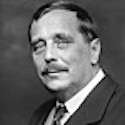 from the library. He decided then and there that he would be a writer. But first he had to get his education, which he did on his own, overcoming much financial and personal hardship -- both things that shaped his writing. Eventually he earned an advanced degree in biology.
That scientific background stood him in good stead when he started writing his “fantastical” stories that became the foundation for what would be termed “science” fiction. Also an artist, Wells made part of his living doing sketches but noted “I had rather be called a journalist than an artist” since it was also during that time – in his late 20s and 30s – that he started writing social commentary in both newspapers and magazines. But, while he was widely read in other genres, it was his science fiction that made him famous.
Wells noted that an author should always strive to make a story as credible as possible, even if both the writer and the reader knew certain elements are impossible. That allows a reader to accept the ideas as something that could really happen, he noted. Today, that is called "making the plausible impossible."
“What really matters,” he said, “is what you do with what you have.”
Share A Writer’s Moment with a friend by clicking the g+1 button below.
September 20, 2016
Writing fictionalized 'truth'
“All fiction has to have a certain amount of truth in it to be powerful.”– George R. R. Martin
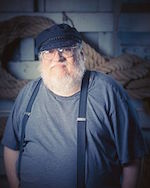
Best known for his series of novels that have led to the epic HBO production, Game of Thrones, Martin has had a long and extremely interesting career, writing both novels and short stories in the fantasy, horror, and science fiction genres. Also a screenwriter, television producer and longtime writing teacher, he said he intended the Game of Thrones series to be 3 books. That was in 1991 when he first started them, and now he’s hard at work trying to finish the 6th and 7thinstallments – all very long, extremely good, and wonderfully complex.
Born on this date in 1948, Martin grew up in New Jersey but said his voracious appetite for all kinds of stories and books made him a citizen of the world and of history. He said just as he used to lose himself in the books he was reading, he finds a similar effect from his own writing.
“The odd thing about being a writer is you do tend to lose yourself in your books. Sometimes it seems like real life is flickering by and you're hardly a part of it. You remember the events in your books better than you remember the events that actually took place when you were writing them.
The winner of some two dozen major national and international writing awards, Martin said he has many, many files of ideas that he hopes to get to once he has completed his massive Game of Thrones opus. As to advice to new writers:
“Start with short stories,” he advises.
“After all, if you were taking up rock climbing, you wouldn't start with Mount Everest. So if you're starting fantasy (or any genre), don't start with a nine-book series.”
Share A Writer’s Moment with a friend by clicking the g+1 button below.
September 19, 2016
The 'magical' world of writing
“I just love writing. It's magical, it's somewhere else to go, it's somewhere much more dreadful, somewhere much more exciting. Somewhere I feel I belong, possibly more than in the so-called real world.” – Tanith Lee
The proilific Lee, born on this date in 1947 (and who died last year), produced an amazing body of work in science fiction, horror, and fantasy. She was the author of over 90 novels and 300 short stories, a children's picture book (Animal Castle), and many poems. And, she was the first woman to win the British Fantasy Award best novel award for her book Death's Master.
Despite her success with adult fiction, a large part of her output was children's fantasy, which spanned her entire career from The Dragon Hoard in 1971 (her first book) to the more recent The Claidi Journals containing Wolf Tower, Wolf Star, Wolf Queenand Wolf Wing.
Much of her work, she said, came from "small things" rather than major inspirations, and as to her preference for what she liked to write, she replied, “Writing is writing, and stories are stories. Perhaps the only true genres are fiction and non-fiction. And even there, who can be sure? I just write.”
As for who should write, she said simply,
 “Writers tell stories better, because they've had more practice, but EVERYONE has a book in them. Yes, that old cliche. I believe it's true.”
Share A Writer’s Moment with a friend by clicking the g+1 button below.
September 18, 2016
A unique 'writer' combination
“Family legends confirm that I've been a storyteller pretty much from the moment I learned to talk. I quickly learned that character, pacing and plot were important to any work of fiction, but that nothing was more important than believability.” – Lynn Abbey
Abbey, born on this date in 1948 in Upstate New York, brings a unique combination to her writing – being first a computer programmer and then a writer. Another interesting part of her background is that she has a master’s degree in European history and a B.A. in astrophysics – one of the first to earn that degree in the 1960s. But with her background in history, she said, “I love to curl up with a book about some dusty corner of history.”
But, in spite of that, her own writing began and mostly remains in science fiction. She broke into the field in 1979 with her novel Daughter of the Bright Moon and the short story "The Face of Chaos," part of a Thieves World shared world anthology. She said she’s a big fan of anthologies because editors are interested in all comers, and you have a great chance to be included even if you’re a beginning writer.
Thus, In 2002, she not only returned to Thieves World with the novel Sanctuary, but she also began editing new anthologies, beginning with Turning Points. And, she said, she’s a big fan of short stories and writers of short stories.
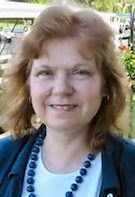
“For me,” she said, “writing a short story is much, much harder than writing a novel. Short-story writing requires an exquisite sense of balance. Novelists, frankly, can get away with more. A novel can have a dull spot or two, because the reader has made a different commitment.”
Share A Writer’s Moment with a friend by clicking the g+1 button below.
September 17, 2016
Star-Gazing: Saturday's Poem
“A poet should always be 'collaborating' with his public, but this public, in the mass, cannot make itself heard, and he has to guess at its requirements and its criticisms.” – Louis MacNeice
Irish poet MacNeice’s body of work was widely appreciated by the public during his lifetime (1907-63), due in part to his relaxed, but socially and emotionally aware style. He was part of the generation called the Auden Group, also sometimes known as the "Thirties poets,” that included W. H. Auden, Stephen Spender and Cecil Day-Lewis (father of renowned actor Daniel Day-Lewis).
Here for Saturday’s Poem is a poem MacNeice plaintively wrote on the occasion of his 50th birthday.
Star-GazerForty-two years ago (to me if to no one else
The number is of some interest) it was a brilliant starry night
And the westward train was empty and had no corridors
So darting from side to side I could catch the unwonted sight
Of those almost intolerably bright
Holes, punched in the sky, which excited me partly because
Of their Latin names and partly because I had read in the textbooks
How very far off they were, it seemed their light
Had left them (some at least) long years before I was.
And this remembering now I mark that what
Light was leaving some of them at least then,
Forty-two years ago, will never arrive
In time for me to catch it, which light when
It does get here may find that there is not
Anyone left alive
To run from side to side in a late night train
Admiring it and adding thoughts in vain.
Share A Writer’s Moment with a friend by clicking the g+1 button below.
September 16, 2016
Spawned by 'The Power to Read'
“When you have a novel set in a fictional history, you still should get your history right.” – Kurt Busiek
Born on this date in 1960, award-winning comics writer Busiek got started during his senior year in college when he submitted some sample scripts to editor Dick Giordano at DC Comics. None of them sold, but they did get him invitations to pitch other material to DC editors, which led to his first professional work, a back-up story in Green Lantern.
By 1993, Busiek and was teaming with artist Alex Ross and together they produced the Marvels limited series which, as comics historian Matthew K. Manning notes, "reinvigorated painted comics as a genre, went on to become an acclaimed masterpiece, and spawned more than its own fair share of imitators."Busiek has been the winner of numerous awards
 as “best writer” for the Marvel Series, The Avengers, which also have been made into several movies, and a version of Conan the Barbarian. Since 2006 he’s also done extensive writing of stories about Spiderman, Superman, Batman and Wonder Woman.
“I could name you a dozen superheroes whose powers I'd like to have. But if I could have any power in the world, it would be the power to read or watch a creative work and absorb the technical skill of the people who made it,” he said. “Because then I could have even more fun writing. That's my core identity. I'm a writer. I just love telling stories.”
Share A Writer’s Moment with a friend by clicking the g+1 button below.
September 15, 2016
Small openings to a huge world
“A picture book is a small door to the enormous world of the visual arts, and they're often the first art a young person sees.” – Tomie dePaola Born on this date in 1934, dePaola has created more than 200 children's books, and is known best for picture books such as Strega Nona. In 2011, he was honored for his lifetime contribution to American children’s literature with the prestigious Laura Ingalls Wilder Award, presented by the American Children’s Librarians Association. He’s also been a finalist for the international Hans Christian Andersen Award. A native of Connecticut, dePaola was first going to be an art teacher, earning several degrees, including the equivalent of a Ph.D. in art while teaching at a number of colleges and universities. But, after his books became successful, he left the teaching world in 1978 to concentrate full time on his adopted profession.His lush artistic style has earned him legions
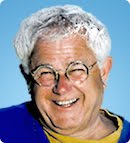 of followers – kids and their parents alike – and he’s worked in a number of areas ranging from his famous Strega Nona series to memoirs, legends, folk tales and religion. It’s in religion that he’s also earned accolades for his fine art, creating numerous significant pieces that are displayed at museums and religious centers around the country.
DePaola was attracted to art at an early age and credits his family with encouraging his development as an artist and influencing the themes of his works. “I remember feeling guilty that I had a good childhood. I thought everybody who is famous has to have a desperate childhood and work his way out of it, but I had a great one.”
Share A Writer’s Moment with a friend by clicking the g+1 button below.
September 14, 2016
Birthing a children's book classic
“I lived with them in my studio in New York. And of course if I were doing that book today or even ten years, fifteen years later, I would have gone to where the wild ducks were and where I could study them - I would have gone to the country somewhere.” – Robert McCloskey
The “they” McCloskey refers to are several mallard ducks he purchased and took home in order to study their movements, sounds and actions. The result was one of the Children’s Book World’s most well-known books, Make Way for Ducklings.
Today is the 102ndanniversary of McCloskey’s birth. In his lifetime he wrote and illustrated children’s books that remain as classics. Make Way was one of two to win the prestigious Caldecott Medal (in 1942), awarded in recognition of the year’s best-illustrated picture book. McCloskey also won for Time of Wonder, and 3 other of his books, including the wonderful Blueberries for Sal, were finalists. He was the first writer/artist to win more than once.
Make Way features a mallard pair that nests on an island in Boston’s Charles River. After raising 8 ducklings, the mother leads them to the Public Garden in downtown Boston. Famously, a friendly policeman stops traffic for them to cross a busy street. The beloved story has become a Boston institution.
In 1987, renowned sculptor Nancy Schön created a bronze version of Mrs. Mallard and the ducklings, installing them near a downtown Boston park where thousands of children climb them and many more people photograph them annually. The park is also the site of an annual Make Way for Ducklings Mother's Day parade, featuring hundreds of children dressed in the costumes of their favorite characters.
 Since 2003, when McCloskey died, Make Way for Ducklings has been the official children's book of Massachusetts.
“I get a lot of letters,” McCloskey once noted. “Not only from children but from adults, too. Almost every week, every month, clippings come in from some part of the world where ducks are crossing the street.”
Share A Writer’s Moment with a friend by clicking the g+1 button below.