Dan Jorgensen's Blog, page 462
November 1, 2016
One of our best 'small town' writers
“I think as the world changes, we have to keep up. We have to note what is happening, and I think writing has always had a powerful corrective influence and possibility. We have to write about what's good, and we also have to write about parts of our culture that are not good, that are not working out. I think it takes a new eye.” – Lee Smith
American fiction author Smith, who celebrates her 72nd birthday today, typically incorporates much of her background from the Southeastern United States in her works. She has received writing awards, such as the O. Henry Award, the American Academy of Arts and Letters Award for Fiction, the North Carolina Award for Literature, and, in April 2013, was the first recipient of Mercer University's Sidney Lanier Prize for Southern Literature.
I really enjoy her work because it not only is well written, it resonates with my own background of coming from a rural area and small town America. “I write about people in small towns; I don't write about people living in big cities,” Smith said. “My kind of storytelling depends upon people that have time to talk to each other.” Imagine that!Smith published her first novel 45 years ago, and
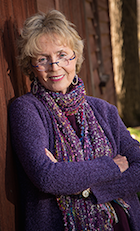 in the intervening years, she’s published 12 more novels and four short story collections. Her novel The Last Girls was listed on the New York Times bestseller's list and won the Southern Book Critics Circle Award.
Her advice for young writers is not to use up all their own story in their very first efforts. “I think what happens to young writers is that they use up every life experience that they have had up to that point for their first novel. Then you have to come up with something for the second novel, but you really don't have anything to say.”
Share A Writer’s Moment with a friend by clicking the g+1 button below.


October 31, 2016
Way beyond 'squiggles' on the page
“A story is open-ended. A story invites you into it to make your own meaning.” – Katherine Paterson
Best known for children's novels, Paterson celebrates her 84th birthday today. Over her lifetime she has won two Newbery Medals and two National Book Awards. Bridge to Terabithia, her most widely read work, was both a Newbery winner and highly controversial at the time it was published (1977) because her youthful protagonists take on themes considered adult in nature. But, they also learn about triumphing through self-sacrifice and how to deal with death and jealousy. Although her characters often face dire situations, Paterson writes with compassion and empathy, interlacing her writing with wry wit and understated humor. “The problem with people who are afraid of imagination,
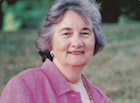
of fantasy,” she said of her detractors, “is that their world becomes so narrow that I don't see how they can imagine beyond what their senses can verify. We know from science that there are entire worlds that our senses can't verify.”
For her career contribution to "children's and young adult literature in the broadest sense" she won the Astrid Lindgren Memorial Award from the Swedish Arts Council in 2006, the biggest monetary prize in children's literature. Also for her body of work she was awarded the NSK Neustadt Prize for Children's Literature in 2007 and the Laura Ingalls Wilder Medal from the American Library Association in 2013.
“Reading asks that you bring your whole life experience and your ability to decode the written word and your creative imagination to the page and be a co-author with the writer,” Paterson said. “Because the story is just squiggles on the page unless you have a reader.”
Share A Writer’s Moment with a friend by clicking the g+1 button below.
October 30, 2016
Thought-provoking views of power
“I am trying to make clear through my writing something which I believe: that biography- history in general- can be literature in the deepest and highest sense of that term.”– Robert Caro
Caro, born on this date in 1935, is best known for his celebrated biographies of United States political figures Robert Moses and Lyndon B. Johnson. In a few days (Nov. 6th) he will receive the National Book Award medal for lifetime achievement.
A native of New York City, Caro started in journalism while studying at Princeton University. He began his professional career as a reporter with the New Brunswick (N.J.) Daily Home News, and from there he went on to six years as an investigative reporter with the Long Island newspaper Newsday.
After working for many years as a reporter, Caro came in contact with urban planner Moses and the influence he had on numerous projects in New York City and the state of New York. Fascinated by Moses’ power, he wrote The Power Broker in 1974. The book not only rose to the top of most best-seller lists, but also was chosen by the Modern Library as one of the hundred greatest nonfiction books of the 20th Century. He has since written four of a planned five volumes of The Years of Lyndon Johnson (1982, 1990, 2002, 2012), a biography of the former president. For his biographies, he has won almost every possible literary award including two Pulitzer Prizes in Biography and the National Book Award for The Power Broker.While the Johnson books have received numerous
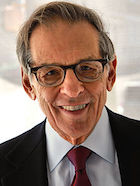 accolades too, it is The Power Brokerthat is widely viewed as a seminal work because it combined painstaking historical research with a smoothly flowing narrative writing style.
 Lauded for his exploration of how power both shapes lives and shapes decisions, he noted, “I never wanted to do biography just to tell the life of a famous man. I always wanted to use the life of a man to examine political power, because democracy shapes our lives.”
Share A Writer’s Moment with a friend by clicking the g+1 button below.
October 29, 2016
A 'familiar' poetic outlook
“If someone is alone reading my poems, I hope it would be like reading someone's notebook. A record. Of a place, beauty, difficulty. A familiar daily struggle.” – Fanny Howe
Poet, novelist, and short story writer, Howe (who recently celebrated her 76thbirthday) was awarded the 2009 Ruth Lilly Poetry Prize, presented annually by the Poetry Foundation to a living U.S. poet whose lifetime accomplishments warrant extraordinary recognition.Howe has become one of the most widely read American poets.
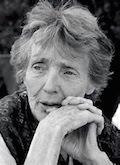 Her prose poems, "Everything's a Fake" and "Doubt,” were selected for the anthology Great American Prose Poems: from Poe to the Present. And, her poem "Catholic" was selected for the 2004 volume of The Best American Poetry.For Saturday’s Poem, here is Howe’s Footsteps I have never arrived
into a new life yet.
Have you?
Do you find the squeak
of boots on snow
excruciating?
Have you heard people
say, It wasn't me,
when they accomplished
a great feat?
I have, often.
But rarely.
•
Possibility
is one of the elements.
It keeps things going.
The ferry
with its ratty engine
and exactitude at chugging
into blocks and chains.
Returning as ever
to mother's house
under a salty rain.
Share A Writer’s Moment with a friend by clicking the g+1 button below.
October 28, 2016
Keeping 'introversion' off the table
“TV’s not the problem, and I'm tired of it being posed as this antithesis to creativity and productivity. If TV's getting in your way of writing a book, then you don't want to write a book bad enough.” – Andrea Seigel
Young Adult novelist Seigel – who grew up in California and then did her writing education on the East Coast (at Brown and Bennington) – turns 37 today and says she’s a great example of how an introvert can be succerssful in an extrovert’s world. Author of 4 novels with a 5th on the way, she also has become a successful screenwriter and has had 2 of her books – The Kid Table and Everybody Knows Your Name turned into films.
She’s also been the subject of a script, featured on the public radio podcast Mystery Show, and was the focus of an episode of NPR’s popular This American Life program, for a rare neurological disorder from which she suffers. Popular with young readers for her realistic portrayals,
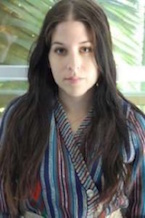
she said she has simple advice for beginning writers about what to remember when they are submitting their work. “Try to remember that decisions are made by individual, fallible personalities, not gods. It's hard. I know.”
Share A Writer’s Moment with a friend by clicking the g+1 button below.
October 27, 2016
Roosevelt - A 'Writing' Life
“I am a part of everything that I have read.” – Theodore Roosevelt
I’ve written before about our 26thPresident, including having him as an integral part of my novel And The Wind Whispered. But, it seems only right to say a few more words about him today on the occasion of what would have been his 168thbirthday.
Born on this day in 1858, this statesman, explorer, soldier, naturalist, and reformer who played a major role in the development of this country’s national parks, monuments and history itself also was one of our great writers.
Roosevelt was a prolific author, writing with passion on subjects ranging from foreign policy to the importance of the national park system. He also was an avid reader, devouring up to 7 books each and every week, even during the most hectic and trying days of his presidency. Among his favorites were books of poetry, and one of our country’s poet laureates, Robert Frost, once said that Roosevelt "was our kind. He quoted poetry to me. He knew poetry."In all, Roosevelt wrote 18 books (each in several
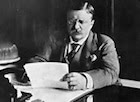 editions), including The Rough Riders, his acclaimed autobiography, and History of the Naval War of 1812 (still taught in naval war classes). He also wrote about ranching, explorations, and wildlife, something he experienced first hand. He also served as editor of Outlookmagazine, where he had weekly access to a large, educated national audience. His thoughtful writings and wise editorial decisions played a key role in protecting some of our country’s most valuable natural sites and resources.
“Nobody cares how much you know, until they know how much you care,” Roosevelt said. “Nine-tenths of wisdom is being wise in time.”
Share A Writer’s Moment with a friend by clicking the g+1 button below.
Almost always 'wise' in time
“I am a part of everything that I have read.” – Theodore Roosevelt
I’ve written before about our 26thPresident, including having him as an integral part of my novel And The Wind Whispered. But, it seems only right to say a few more words about him today on the occasion of what would have been his 168thbirthday.
Born on this day in 1858, this statesman, explorer, soldier, naturalist, and reformer who played a major role in the development of this country’s national parks, monuments and history itself also was one of our great writers.
Roosevelt was a prolific author, writing with passion on subjects ranging from foreign policy to the importance of the national park system. He also was an avid reader, devouring up to 7 books each and every week, even during the most hectic and trying days of his presidency. Among his favorites were books of poetry, and one of our country’s poet laureates, Robert Frost, once said that Roosevelt "was our kind. He quoted poetry to me. He knew poetry."In all, Roosevelt wrote 18 books (each in several
editions), including The Rough Riders, his acclaimed autobiography, and History of the Naval War of 1812 (still taught in naval war classes). He also wrote about ranching, explorations, and wildlife, something he experienced first hand. He also served as editor of Outlookmagazine, where he had weekly access to a large, educated national audience. His thoughtful writings and wise editorial decisions played a key role in protecting some of our country’s most valuable natural sites and resources.“Nobody cares how much you know, until they know how much you care,” Roosevelt said. “Nine-tenths of wisdom is being wise in time.”
Share A Writer’s Moment with a friend by clicking the g+1 button below.
October 26, 2016
Carrying our collective stories
“Nonfiction writers are the packhorses of literature. We're meant to carry the story. If we can make it up and down the mountain by a reliable if not scenic route, we have delivered. Technique is optional.” – Stacy Schiff
Born on this day in 1961, Schiff started her career as an editor and was the senior editor at Simon & Schuster until 1990. That’s when she shifted into writing and, in particular, began her focus on biography and non-fiction. Since then she has written half-a-dozen acclaimed biographies and nonfiction bestsellers sandwiched around numerous essays and articles in such notable magazines and newspapers as The New Yorker, The New York Times, The Times Literary Supplement and The New York Times Book Review.
After being a finalist for the 1995 Pulitzer Prize for her biography of Antoine de Saint Expurey (author of The Little Prince), Schiff won the 2000 Pulitizer for Vera, about Vera Nabokov, wife and muse of Nobel Prize winner Vladimir Nabokov.
Her fourth book, Cleopatra: A Life, was published to great acclaim in 2010. As the Wall Street Journal's reviewer put it, "Schiff does a rare thing: She gives us a book we'd miss if it didn't exist." The New Yorker termed the book "a work of literature." Last year, she published The Witches: Salem, 1692 hailed by The New York Times as "an almost novelistic, thriller-like narrative.”
 Schiff said she very much enjoys research but sometimes runs into walls trying to decipher her subjects’ writing and works. “In an ideal world,” she said, “ the perfect biographical subject would have been the star of his penmanship class at grade school - and would thereafter write an English that positively sings.”
 As for biography as her topic, something a novelist friend once told her “was not a real book,” she added, “The biographer has two lives: The one she leads, and the one she ultimately understands.”
Share A Writer’s Moment with a friend by clicking the g+1 button below.
October 25, 2016
Letting your stories 'shine through'
“What I hope for from a book - either one that I write or one that I read - is transparency. I want the story to shine through. I don't want to think of the writer.” – Anne Tyler
Author of the Pulitzer Prize-winning novel, The Accidental Tourist, and the Time Magazine Book of the Year Breathing Lessons, Tyler celebrates her 75thbirthday today. Still going strong, she has only recently released her 19th and 20th books, A Spool of Blue Thread and Vinegar Girl. Ever self-deprecating and low key, Tyler once said that while she was waiting for her child after school, another mother came up and asked if she’d found full-time work yet or she was still “just writing.”
Born in Minneapolis, Tyler was raised in various parts of the country and often felt like an outsider, a factor that she said helped make her a better writer and storyteller. Her first reminiscences of storytelling were at age 3, when she said she’d crawl under the covers and tell herself stories to help go to sleep. She was already writing stories at age 7.
Although she was only “in-and-out” of formal schools, she finished high school at age 16 and enrolled at Duke University where she took renowned novelist and poet Reynolds Price’s first creative writing class. Price later described her as “frighteningly mature for 16,” "wide-eyed,” “an outsider,” and “one of the best novelists alive in the world… almost as good a writer at 16 as she is now.”
Besides the Pulitzer, Tyler is the recipient of the Janet Heidinger Kafka Prize, the Ambassador Book Award,
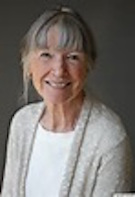 the National Book Critics Circle Award, and The Sunday Times Award for Literary Excellence in 2012. Five of her novels have been made into movies, including the widely acclaimed version of Accidental Tourist.
To young writers, she says, “I would advise any beginning writer to write the first drafts as if no one else will ever read them - without a thought about publication - and only in the last draft to consider how the work will look from the outside.”
Share A Writer’s Moment with a friend by clicking the g+1 button below.
October 24, 2016
Writing 'to fit' the tale
“Writers should be applauded for their ability to make things up.” – Emma Donoghue
While (hopefully) she’s talking about fiction, she’s also written a number of great essays and nonfiction works and earned plenty of applause for almost everything she’s done.
Born on this date in 1962, Irish-Canadian playwright, literary historian, novelist, and screenwriter Donoghue is perhaps best known for her 2010 novel Room, a finalist for the prestigious Man Booker Prize, an international best-seller, and the Academy Award-nominated movie by the same name (for which she adapted the screenplay). Donoghue, who was born in Ireland but makes her
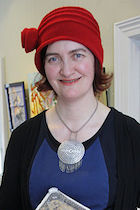 home in Canada, has written one award winner after another – 17 books in all, including her 2016 psycho-drama The Wonder –since she started writing at age 23. While many of her works are “historical fiction,” she’s been hard to categorize – something for which she’s very happy.
“You know the way there are two kinds of actors - the De Niro kind who's always De Niro, and then somebody like Daniel Day-Lewis, who transforms himself eerily? Well, I aim to be the Daniel Day-Lewis kind of writer. I don't have a house style.”
Share A Writer’s Moment with a friend by clicking the g+1 button below.