Dan Jorgensen's Blog, page 390
October 10, 2018
The writing tools that fit
“Every writer has to figure out what works best - and often has to select and discard different tools before they find the one that fits.”– Nora Roberts
Roberts, born on this date in 1950, was the first author to be inducted into the Romance Writers of America Hall of Fame and has written an astounding (and still counting) 225 novels, many of which have reached the number one spot on the New York Times Best Seller list.
A native of Silver Spring, MD (the Washington, DC, suburb my oldest daughter and family call home), she has combined her prolific writing career with a prolific support of charitable causes, particularly those that encourage literacy, the arts, and humanitarian causes. Her Foundation has endowed the Nora Roberts Center for American Romance at Maryland’s McDaniel College, supporting academic scholarship on the American romance novel.
 While all of her books seem to reach bestseller status, Year One, Come Sundown, The Obsession, and The Liarhave led the list of the more than 500 million copies of her books in print. And she loves her writing and writing – and reading – about romance.
 “I don't believe for one moment,” she said, “that you can write well what you wouldn't read for pleasure.”
Share A Writers Read more at: Moment with a friend by clicking the g+1 button below


October 9, 2018
Immersing readers into the story
“I just want people to get lost in the story and at the end kind of sag and say, 'That was fun.' It's hardly my desire for them to sit and think, 'What a great literary image.'” – Michael Palmer
Born on this date in 1942, Palmerwas both a medical doctor and a bestselling author who wrote a medical thrillers, many of which made the New York Times Best Seller List. His books have been translated into 35 languages and one, Extreme Measures, was adopted into a popular film starring Hugh Grant and Sarah Jessica Parker.
 A native of Massachusetts, Palmer once claimed he never wanted to be a writer because he didn’t think he had the "flair" for it, but after reading fellow Wesleyan alum Robin Cook’s medical thriller Coma he decided if Cook could write a novel, he could too. He ended up writing 22.
 Among his most popular – in addition to Extreme Measures – were Side Effects, Natural Causes, and his 3-book Dr. Lou Welcome series, the final book released shortly after his sudden death from a heart attack in 2013.
When asked, Palmer said he always believed he had some sort of a creative streak hidden inside that led him into writing. “But then again,” he added, “I always thought I could win a gold medal in the Olympics, too, if they would just invent the sport that I was the best at.”
Share A Writer’s Moment with a friend by clicking the g+1 button below.
Immersing readers in his stories
“I just want people to get lost in the story and at the end kind of sag and say, 'That was fun.' It's hardly my desire for them to sit and think, 'What a great literary image.'” – Michael Palmer
Born on this date in 1942, Palmerwas both a medical doctor and a bestselling author who wrote a medical thrillers, many of which made the New York Times Best Seller List. His books have been translated into 35 languages and one, Extreme Measures, was adopted into a popular film starring Hugh Grant and Sarah Jessica Parker.
A native of Massachusetts, Palmer once claimed he never wanted to be a writer because he didn’t think he had the "flair" for it, but after reading fellow Wesleyan alum Robin Cook’s medical thriller Coma he decided if Cook could write a novel, he could too. He ended up writing 22. Among his most popular – in addition to Extreme Measures – were Side Effects, Natural Causes, and his 3-book Dr. Lou Welcome series, the final book released shortly after his sudden death from a heart attack in 2013.
When asked, Palmer said he always believed he had some sort of a creative streak hidden inside that led him into writing. “But then again,” he added, “I always thought I could win a gold medal in the Olympics, too, if they would just invent the sport that I was the best at.”
Share A Writer’s Moment with a friend by clicking the g+1 button below.
October 6, 2018
The emotional recordings of poetry
“A poem records emotions and moods that lie beyond normal language, that can only be patched together and hinted at metaphorically.”– Diane Ackerman
Poet, essayist, and naturalist – known for her wide-ranging curiosity and poetic explorations of the natural world –Ackerman was born on Oct. 7, 1948, currently resides in Ithaca, NY. Among her best-known poetic works is the collection Jaguar of My Destroyer: New and Collected Poems.
 Also known for her study of and essays on the senses, she said she is fascinated by how they affect people’s lives. “We live on the leash of our senses,” she said. For Saturday’s poem, here is Ackerman’s,
 School Prayer
In the name of the daybreak
and the eyelids of morning
and the wayfaring moon
and the night when it departs,
I swear I will not dishonor
my soul with hatred,
but offer myself humbly
as a guardian of nature,
as a healer of misery,
as a messenger of wonder,
as an architect of peace.
In the name of the sun and its mirrors
and the day that embraces it
and the cloud veils drawn over it
and the uttermost night
and the male and the female
and the plants bursting with seed
and the crowning seasons
of the firefly and the apple,
I will honor all life
—wherever and in whatever form
it may dwell—on Earth my home,
and in the mansions of the stars.
Share A Writer’s Moment with a friend by clicking the g+1 button below
October 5, 2018
Writing the 'Spirit of Place'
“It may seem unfashionable to say so, but historians should seize the imagination as well as the intellect. History is, in a sense, a story, a narrative of adventure and of vision, of character and of incident. It is also a portrait of the great general drama of the human spirit.” – Peter Ackroyd
Born on this date in 1949, Ackroyd is an English biographer, novelist and critic who has written some of the best biographical pieces on luminaries like William Blake, Charles Dickens and T.S. Eliot. But his historical novels have earned him the most acclaim, including the Somerset Maugham Award and two Whitbread Awards. He is noted for the volume of his work (36 nonfiction books; 18 novels and 3 books of poetry), and the depth of his research.
His novel The Great Fire of London, a reworking of Dickens’ Little Dorrit (a terrific example, by the way, of the “serial” writing style that first made Dickens popular), put Ackroyd on the writing map.
 That book set the stage for his many novels dealing with the complex interaction of time and space and what Ackroyd calls "the spirit of place.” “I don’t think I ever read a novel until I was 26 or 27,” he said. “I wanted to be a poet … (and) had no interest in fiction or biography and precious little interest in history. But those three elements in my life have become the most important.”
Share A Writer’s Moment with a friend by clicking the g+1 button below
October 4, 2018
Sparked by a love of words
“I love words. I love to sing them and speak them and . . . I have fallen into the joy of writing them.” –Anne Rice
Born in New Orleans on this date in 1941, Rice is perhaps best known for her series of novels, The Vampire Chronicles, all best-sellers and the basis for two popular movies, led by Interview with the Vampire, which began her professional writing career in 1976. Rice's books have sold nearly 100 million copies, placing her among the most popular authors in recent American history.
In addition to her vampire novels, Rice has authored books such as The Feast of All Saints (recently adapted for television) and Servant of the Bones, which formed the basis for a comic book miniseries.
Rice is a big fan of English author Charles Dickens, who she says is not only underrated but under-read, and she encourages other writers and her fans to read Dickens’ whenever they get the chance.
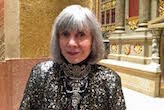 A frequent speaker she encourages new writers to use whatever technique, style or "encouragement" that they can; whatever sparks their writing skills.
 “Obsession led me to write,” she said about her own discovery. “It's been that way with every book I've ever written. I become completely consumed by a theme, by characters, by a desire to meet a challenge.”
Share A Writer’s Moment with a friend by clicking the g+1 button below
October 3, 2018
A writing life not sought
“I didn't mean to spend my life writing American history, which should have been taught in the schools, but I saw no alternative but to taking it on myself. I could think of a lot of cheerier things I'd rather be doing than analyzing George Washington and Aaron Burr. But it came to pass, that was my job, so I did it.”– Gore Vidal
Vidal was born on this day in 1925 at West Point, NY, where his father was a military officer serving as the first instructor of aeronautics in the Military Academy’s history. He would become one of the most well known and sometimes controversial writers in American history, doing novels, essays, screenplays and stage plays and taking on a larger-than-life public role as an intellectual, debater and historian.
He wrote 28 nonfiction books, 32 novels, 8 plays, and 16 screenplays and teleplays. Many of his books were best sellers, but especially gripping were his historical novels Burr, Lincoln, 1876 and Empire. Vidal won the National Book Award for Nonfiction for the anthology United States: Essays 1952–92.
“I never wanted to be a writer. I mean, for me, that was the last thing I wanted,” he said shortly before his death in 2012.
 And as for writing in America today, he added, “You hear all this whining going on, 'Where are our great writers?' The thing I might feel doleful about is: Where are the readers?”
Share A Writer’s Moment with a friend by clicking the g+1 button below
October 2, 2018
'Just present things as they are'
“As a writer, I've tried to avoid strong opinions about morality. You just want to present things as they are and let the viewer come to their own conclusion.”– Terence Winter
Born on this date in New York City, Winter studied to be a lawyer before realizing that what he really wanted to do was create shows for television and the movies. Today, he is one of America’s most successful TV and movie writers and producers with such hit series as Boardwalk Empireand The Sopranos to his credit. He also was nominated for an Academy Award for the movie The Wolf of Wall Street.
A frequent speaker about writing for the stage and screen, he has this basic advice for would-be writers and producers.
“I have a rule: I will not alter the basic history of a real-life character to suit fictional needs in a big way.” Winter said.
 “First and foremost, you want to be truthful as a storyteller.”
Share A Writer’s Moment with a friend by clicking the g+1 button below.
October 1, 2018
Words that flow like a river
“What makes a river so restful to people is that it doesn't have any doubt - it is sure to get where it is going, and it doesn't want to go anywhere else.”– Hal Boyle
While he wrote mostly of nature in his final years, Boyle (born in Missouri in 1911) is best known for his work as a war correspondent and writer at conflicts and troubled spots around the world, and for his Pulitzer Prize-winning newspaper column, which appeared nearly 8,000 times during his career.
Boyle’s column became a staple in over 700 newspapers, and he was one of those “must read” writers for those of us interested in becoming journalists. For a great “sample” of his work, check out the book The Best of Boyle. And, to see and hear Boyle, check out the 1945 film dramatization of Ernie Pyle's book, The Story of G.I. Joe, where Boyle portrayed himself.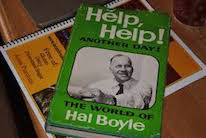
Shortly before his death in 1974 and thoroughly disgusted and ashamed of how people treated each other and the earth, he noted, “We need not worry so much about what man descends from - it's what he descends to that shames the human race.”
Share A Writer’s Moment with a friend by clicking the g+1 button below
While he wrote mostly of nature in his final years, Boyle (born in Missouri in 1911) is best known for his work as a war correspondent and writer at conflicts and troubled spots around the world, and for his Pulitzer Prize-winning newspaper column, which appeared nearly 8,000 times during his career.
Boyle’s column became a staple in over 700 newspapers, and he was one of those “must read” writers for those of us interested in becoming journalists. For a great “sample” of his work, check out the book The Best of Boyle. And, to see and hear Boyle, check out the 1945 film dramatization of Ernie Pyle's book, The Story of G.I. Joe, where Boyle portrayed himself.

Shortly before his death in 1974 and thoroughly disgusted and ashamed of how people treated each other and the earth, he noted, “We need not worry so much about what man descends from - it's what he descends to that shames the human race.”
Share A Writer’s Moment with a friend by clicking the g+1 button below
September 29, 2018
Poetry is a 'practical cat'
“Genuine poetry can communicate before it is understood.”– T. S. Eliot
Born in America in September 1888, Eliot was an essayist, publisher, playwright, literary, social critic, and one of the twentieth century's major poets. He moved to England in 1914 at the age of 25, settling, working, and marrying there.
 He became a British subject in 1927.
Awarded the Nobel Prize in Literature in 1948, he wrote some of the best-known poems in the English language, including The Waste Land, "The Hollow Men,” and "Ash Wednesday” and seven hit plays led by the much-performed Murder in the Cathedral. His book Old Possum’s Book of Practical Cats became the foundation for the long-running Broadway musical “Cats.” Here, from that book – and for Saturday’s Poem – is Eliot’s,
The Naming of Cats
The Naming of Cats is a difficult matter,
It isn’t just one of your holiday games;
You may think at first I’m as mad as a hatter
When I tell you, a cat must have THREE DIFFERENT NAMES.
First of all, there’s the name that the family use daily,
Such as Peter, Augustus, Alonzo, or James,
Such as Victor or Jonathan, George or Bill Bailey —
All of them sensible everyday names.
There are fancier names if you think they sound sweeter,
Some for the gentlemen, some for the dames:
Such as Plato, Admetus, Electra, Demeter —
But all of them sensible everyday names.
But I tell you, a cat needs a name that’s particular,
A name that’s peculiar, and more dignified,
Else how can he keep up his tail perpendicular,
Or spread out his whiskers, or cherish his pride?
Of names of this kind, I can give you a quorum,
Such as Munkstrap, Quaxo, or Coricopat,
Such as Bombalurina, or else Jellylorum —
Names that never belong to more than one cat.
But above and beyond there’s still one name left over,
And that is the name that you never will guess;
The name that no human research can discover —
But THE CAT HIMSELF KNOWS, and will never confess.
When you notice a cat in profound meditation,
The reason, I tell you, is always the same:
His mind is engaged in a rapt contemplation
Of the thought, of the thought, of the thought of his name:
His ineffable effable
Effanineffable
Deep and inscrutable singular Name.
Share A Writer’s Moment with a friend by clicking the g+1 button below