
Laura Lane's Blog, page 12
January 8, 2020
How to raise a child to feel loved and make a difference
“[Parents] your being there alleviates pain. It takes away a percentage of the side effects and discomfort and everything else than the person who is isolated and alone. Do not feel guilty that you can’t fix it and cure it.” Dr. Bernie Siegel


Full Transcript of Hope Strength Courage Podcast Episode 2 Season 1
How to raise a child to feel loved and make a difference - Laura Lane's Interview with Dr. Bernie Siegel Part 2
January 1, 2020
Full Transcript of Hope Strength Courage Podcast Episode 1 Season 1
How to talk to our children when they are ill - Laura Lane's interview with Dr. Bernie Siegel Part 1
How to talk to our children when they are ill
“Work at loving your life, loving your body and to let the kids do that as well as adults. To look at what will make you happy and to not be angry at your body for having a disease but loving it.” Dr. Bernie Siegel
December 24, 2019
3 Things to remember when supporting a loved one with cancer
It was 4 o’clock in the afternoon on Thursday, February 24, 2011, my husband, Matt, and I had just picked up our 6-year-old son, Grayson, from school. Climbing back into our car, I scrambled to grab my ringing cell phone. It was Michelle, my children’s stepmother. She hurriedly informed me that Celeste, my 12-year-old daughter, was in the emergency department of the Children’s Hospital in London, Ontario. “Celeste has to have emergency neuro [brain] surgery tonight.”
Celeste had been having bad headaches. We had a doctor’s appointment coming, but that morning she started developing double vision. Michelle, a neurology resident, took Celeste to see her doctor that day. He immediately sent Celeste over to the emergency department. They did a CAT scan and an MRI was scheduled. She was scheduled to go into surgery for 9:30 that night. When I arrived at the hospital a few hours before her surgery, her father broke the news that they had discovered a golf ball size tumour under her pineo gland, but they didn’t know if it was cancerous or benign. The surgery would relieve the pressure building up on her brain, causing the headaches and double vision, and hopefully they could get a sample to run a biopsy. They hadn’t told Celeste yet, because they didn’t want to worry her until they knew exactly what was going on.
I was emotionally exhausted before I even stepped into her room, yet adrenaline and focusing on what needed to be done kept me marching on. Armed with her Pooh Bear, blanket, and Winnie the Pooh movie, Celeste waited for her surgery. Looking back, I don’t know how I was so strong; watching them prepare my baby girl, and take her down that long foreboding corridor and into surgery. The wait in the cold, empty waiting room became the longest for 2 and a half hour wait of my life.
This became the beginning of our family’s journey in dealing with childhood cancer.
If you too are one of these families, who have received the heart wrenching news that your child has cancer, I hope that in reading this you too can learn and implement the tools we used in order to cope through this difficult and tiring time.
The first thing you need to remember is that you are not alone.
Minutes after I received that call from Michelle, I was back on the phone, looking to family, friends and members of our church for help. So many arrangements had to made; someone to care for my youngest son, only 6 years old, a place for my husband to stay overnight near the hospital while I camped out in Celeste’s room. I knew you don’t go home right away after brain surgery, but didn’t have any idea how long we would be there: Days? Weeks? I called to arrange for our Bishop to give Celeste a blessing. Could someone take me out shopping for food one day? I wouldn’t have a car and didn’t know where to find the nearest stores. Then came the requests for people to pray for Celeste. If I wasn’t comfortable asking for help for myself, I was certainly willing to ask on behalf of my daughter.
But the most wonderful thing was, that when I did ask for help, people were anxious to help in so many different ways. People are wonderful. Complete strangers opened their homes to us over the coming weeks, months and years. People want the opportunity to help and serve and love. It’s up to you to be courageous enough to ask. I call this “Reaching Out”.
Once the chaos settles down and you develop some sort of routine in the midst of all the appointments, scans, treatments, and hospital stays, you need to make sure that you take small moments for yourself. In order to help your loved one, you need to be at your best; physically, emotionally, mentally, and spiritually. There will be sleepless nights, emotions that run high, huge decisions to be made, and your beliefs about God, the universe, and the purpose of life will surface. You need to take time for yourself or your own fountain will run dry. Make sure that you have someone to talk to, or that someone can spell you off so you can go for a walk or take a much needed nap. Do something to distract your mind. Take a few minutes every day to meditate and quiet those endless worrying thoughts.
Lastly, look for the miracles. In the midst of every tragedy and difficulty there are small miracles that surface. I had a friend drive all the way to the hospital just to pick up and do my laundry for me. People who actions, turn them into angels, during your darkest hours. She was my angel that day. Some days the miracles will be that blood counts are better than yesterday or the tumour has shrunk. Celebrate each one of them, as if they are the greatest milestone that has ever been achieved!
I hope that all together these truths can help you cope with supporting your loved one with cancer, just as they helped me. In our book “Two Mothers One Prayer: Facing your child’s cancer with Hope, Strength and Courage” I share even more insights that I believe can help you in the journey ahead. In it, Laurie and I, share our story of friendship and inspiration, of struggles and miracles, of joy and sadness, and of love and loss, which may comfort and uplift you. I would invite you to order a copy for yourself, or to share with another family whose child is currently battling cancer, and that they too may find hope, strength and courage during this difficult time.
******************
Laura Lane helps parents cope with the diagnosis of their child with cancer or other illness so that they can face each day with hope, strength and courage. Laura lost her own 14 year old daughter to cancer in 2013, published a book “Two Mothers, One Prayer: Facing your child’s cancer with Hope, Strength and Courage” to help parents cope when their child is diagnosed with cancer and has established herself as a spiritual growth and development expert, sharing with her clients and audiences her own story of losing her mother and 7 year sister in a car accident that only she survived at age 9. In her spare time Laura loves speaking, training and teaching about how to find peace and divine perspective through difficult life circumstances.
To find out more, grab her free chapter of “Two Mothers One Prayer: Facing your Child’s Cancer with Hope, Strength and Courage” at www.lauralane.ca/freechapterTMOP
December 18, 2019
EFT – Emotional Freedom Technique or Tapping
I recently shared the complete list (found in the back of Two Mothers One Prayer) of resources that I used to cope while Celeste was diagnosed with cancer and what I refer to as my Emotional Toolbox. I thought I’d go into more detail about each of the resources or tools: what exactly they are and how they helped me.
Emotional Freedom Technique (EFT)
The first one I mentioned was EFT or the Emotional Freedom Technique. The first time I had ever heard of EFT was through my Therapeutic Touch Instructor back in 2005.(I have been a Therapeutic Touch practitioner for over 18 years now. I promise to explain Therapeutic Touch or TT at a later date) Margaret mentioned in passing about using EFT to overcome her extreme fear of spiders.
She described it as also being effective with physical symptoms as well as phobias. Fast forward a year or two and I was experiencing an intense reaction to my many environmental allergies. None of the Allergy medications I tried could give me relief from the chronic sneezing and sinus troubles. I just couldn’t breathe. I was so desperate I wondered if this EFT that Margaret had mentioned could help me in anyway. So that’s when I started searching online to find out more. Gary Craig who founded the technique had a website www.emofree.com with a free manual, I began tapping right then and there, walking myself through the sequence until I could finally breathe again.
I was so relived, first to be able to breathe normally again and secondly to have something that worked and gave me hope after 20+ years of environmental allergies. I knew on my own that I had only garnered myself temporary relief from the sinus problem that day but would need extra help to deal with it further so I looked up a local EFT practitioner to help me. That was my introduction to EFT.
Over the years I learned that EFT was especially useful in helping to reverse the negative emotions that can be the root of many emotional and physical ailments. It wasn’t until Celeste became sick that I was willing to do whatever it took to clear up my own emotional baggage so I could have the strength to help Celeste through everything she was about to face.
I knew to that to be the best mom possible for her I was going to have to finally deal with my emotional crap that I hadn’t been willing to do for myself. I also knew that if I had to do this, I was going to need help and I was willing to ask the best of the best – whoever that may be, to help me. Over the years, within the personal growth and development world I had heard that Carol Look was an expert on EFT or Tapping. So I looked her up, called up her office, explained my situation and asked her who I should work with, if there was someone in the Toronto area that she could recommend for me.
That recommendation was one of the best I have ever received. Vivian became one of my life lines during everything for the next 6 years. Not only is she an exceptional EFT practitioner but also a trauma counselor. And the one thing I have heard over and over from parents of children with cancer – it is traumatic in so many ways. EFT can be used to help parents, but parents can also learn the technique to help their child cope with the stress of treatments as well.
In researching what to share about EFT I discovered a great post written by Dr. Veronique Desaulnier. She shares the research and explanations about EFT:
“Emotional Freedom Technique (also known as EFT or Tapping) is a fast, easy, and effective way to reduce anxiety, clear emotional blocks, and become more peaceful and focused in all areas of your life.”
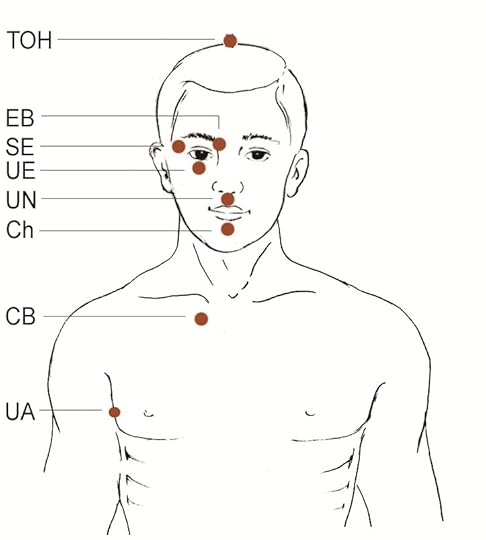
“EFT is done by lightly tapping on specific points on your body (usually eight or nine) between your chest and the top of your head. While tapping, you vocalize first the negative issue at hand (and your feelings about it) and then vocalize a more positive perception of the issue (even if it is just to accept it).
This combination works on an energetic, emotional, and physiological level to clear emotional blocks and bring the mind and body back into balance. On an anatomic level, regularly practicing Tapping and utilizing it in times of stress helps stabilize hormones levels. It will also calm the amygdalae, the part of our limbic system that responds to emotional stimuli and is responsible for the “fight or flight” response.
EFT Tapping has been shown to significantly decrease (and in some cases eliminate) conditions such as:
AnxietyDepressionPTSD /TraumaFood CravingsAddictionsPhobiasTest and Public Speaking AnxietyPhysical PainAccording to physicist Bruce Lipton, author of The Biology of Belief, EFT is also a way to “supercharge” deep emotional healing. This is because it reprograms negative belief patterns to more life-affirming ones. Most of the time we are not aware of the negative beliefs we hold as adults, many of which were formed in childhood. Yet these beliefs can and do contribute to the development of diseases like cancer as we age.
Lipton metaphorically equates the subconscious mind to a tape player: “Tape players are not good nor bad. The programs (that they play) can be good and can be bad … You have to learn how to push the record button to change the program in the subconscious mind.”
According to Lipton, practicing EFT Tapping allows us to “push the record button” on our subconscious mind and replace negative belief systems and patterns with healthy ones.”
To read the whole article and her list of sources visit https://thetruthaboutcancer.com/emotional-freedom-technique-cancer/


